

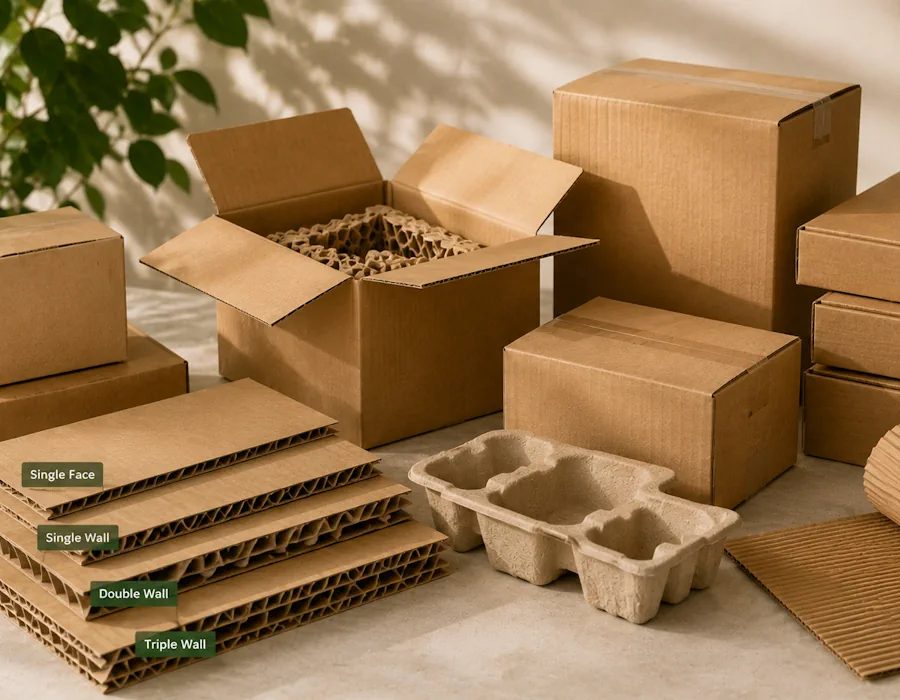
Corrugated packaging is the fluted cardboard material used for most shipping boxes and a large share of secondary and tertiary packaging — the single most widely used packaging material by volume, largely because it delivers strong stacking strength at a low cost and weight relative to almost any alternative. What most people don’t realize is that “corrugated” isn’t one uniform material; flute size, wall count, and board grade all change significantly depending on what a box needs to survive.
What Makes Cardboard “Corrugated”
Corrugated board is built from three layers: two flat linerboard sheets with a fluted (wave-shaped) medium sandwiched between them. That fluted middle layer is what gives corrugated its strength-to-weight advantage over flat paperboard — the wave shape resists crushing in a way a flat sheet of the same material and weight simply can’t. This structure is also why corrugated recycles so effectively: it’s still fundamentally paper-based, accepted by nearly all municipal recycling programs, which is a genuine sustainability advantage over multi-material or heavily coated alternatives.
Flute Sizes and What They’re For
Flute size — the height and density of the fluted layer — is the main variable that determines what a corrugated box is actually suited for. Larger flutes (A-flute) offer the strongest cushioning and stacking strength, generally used for heavier or more fragile items needing maximum protection. Mid-size flutes (B and C-flute) are the most common general-purpose choices, balancing strength with a thinner profile that takes up less shipping volume — C-flute in particular is the default for most standard shipping boxes. Smaller flutes (E and F-flute) are thinner still, favored for retail packaging and smaller items where printability and a cleaner finished look matter more than maximum crush resistance.
Choosing the wrong flute size is a common, avoidable cost issue: over-speccing (using A-flute where C-flute would hold up fine) adds unnecessary material cost and shipping volume, while under-speccing risks damage claims and returns.
Single, Double, and Triple Wall
Beyond flute size, corrugated board also varies in wall count. Single wall, one fluted layer between two liners, is standard for most general shipping and retail boxes. Double wall, two fluted layers, is used for heavier items or situations involving more handling stress, like export shipments or bulk packaging. Triple wall, three fluted layers, is reserved for very heavy industrial applications — it’s rarely necessary outside of large equipment or bulk commodity shipping, and using it where single or double wall would suffice is a straightforward way to overspend on packaging.
Custom Corrugated Packaging
Custom corrugated packaging — specific dimensions, printed branding, die-cut structural features — follows the same general cost logic as custom packaging elsewhere: it requires higher minimum order quantities and longer lead times than stock box sizes, but delivers a stronger, more consistent brand presence at the point where a customer first receives a shipment. For most brands, the practical starting point is standard stock box sizes with custom printing, moving to fully custom die-cut structures only once shipping volume and unboxing experience become a real priority rather than a nice-to-have.
Frequently Asked Questions
What is corrugated packaging made of?
Corrugated packaging is made from three layers of paper: two flat linerboard sheets with a wave-shaped fluted layer, called the medium, sandwiched between them, giving it strength relative to its weight.
What's the difference between corrugated and cardboard?
“Cardboard” is often used loosely to describe both corrugated board and flat paperboard, but they’re structurally different — corrugated has a fluted middle layer for strength, while paperboard is a single flat sheet, generally thinner and used more for retail cartons than shipping boxes.
What flute size should I use for shipping boxes?
C-flute is the most common general-purpose choice for standard shipping boxes, balancing strength and shipping volume. Heavier or more fragile items may need A-flute or double-wall board for additional protection.
Is corrugated packaging recyclable?
Yes — corrugated cardboard is widely accepted by municipal recycling programs and is one of the more straightforwardly recyclable packaging materials, since it’s fundamentally paper-based without the multi-material complications that affect some plastic and composite packaging.




1 Comment