
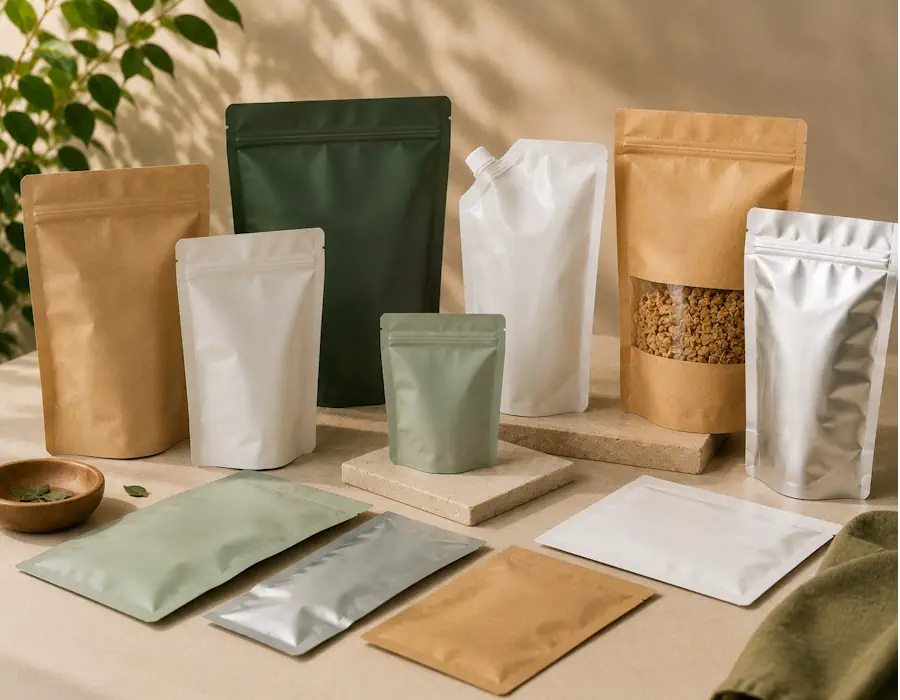
Flexible packaging as a material category is broad — the harder question most brands actually face isn’t “should I use flexible packaging” but “which structure, with how many layers, and what closure.” That’s what “flexible packaging solutions” actually means in practice: matching a specific film structure to a specific product’s barrier, strength, and cost requirements, rather than treating flexible film as one interchangeable option.
Start With What the Package Needs to Survive
Every flexible packaging structure decision comes back to three questions. What has to stay out — oxygen, moisture, light, or some combination, determines the barrier layers a structure needs. What has to stay in, meaning whether the product itself might affect the film from the inside, like an acidic or oily product interacting with certain plastics, determines the inner sealant layer. And what physical stress will the package face — puncture risk from sharp contents, drop resistance for shipping, seal strength for pressurized products — determines the structural layers beyond pure barrier performance.
Most flexible packaging failures trace back to skipping one of these three questions rather than to a fundamentally wrong material choice — a structure with excellent oxygen barrier can still fail if it wasn’t specified for the puncture risk of its actual contents.
Single-Layer vs. Multi-Layer Structures
This is the central structural decision in flexible packaging. Single-layer, or mono-material, film uses one plastic type engineered to deliver the needed properties on its own. It’s considerably easier to recycle, since there’s no lamination to separate, and it’s generally the lower-cost option to produce, but it can’t always match the barrier performance of a purpose-built multi-layer structure, particularly for products with demanding oxygen or moisture barrier needs. Multi-layer film combines several thin layers, each contributing a specific property, laminated together into one structure — this delivers stronger, more precisely tuned barrier performance, but at the cost of being much harder to recycle through standard systems, since separating dissimilar plastic layers isn’t practical at scale.
The industry trend is clearly toward closing this gap: newer mono-material formulations are matching multi-layer barrier performance in more applications each year, though multi-layer structures still lead for the most demanding barrier requirements, like coffee or products needing very long shelf stability.
Matching Structure to Industry
Different industries lean toward different structural solutions based on what actually matters most for their products. Food and beverage generally needs the strongest barrier performance of any category, since oxygen and moisture directly determine shelf life, which is why multi-layer structures remain more common here than in less barrier-sensitive categories. Personal care and cosmetics often prioritize a premium look and feel alongside barrier needs, leading to structures that balance material performance with finish and printability. Industrial and B2B packaging typically prioritizes strength and puncture resistance over barrier precision, since the concern is usually physical damage in handling rather than product freshness.
Closures and Format Considerations
Beyond the film structure itself, closure type is a real part of a flexible packaging solution. Heat seals are the simplest and lowest-cost option but offer no resealability once opened. Zippers and press-to-close closures add resealability at a modest cost increase, increasingly expected by consumers for any product used across multiple sittings. Spouts and valves, as covered in the context of coffee packaging’s degassing requirements, serve specific functional needs beyond simple closure. The right closure choice depends on how a product is actually used after opening, not just how it’s sealed at the point of packaging.
Frequently Asked Questions
Should I choose mono-material or multi-layer flexible packaging?
It depends on your product’s barrier needs and how much you’re prioritizing recyclability. Mono-material is easier to recycle and often lower cost, while multi-layer delivers stronger, more precisely tuned barrier performance for demanding products.
What determines the number of layers in a flexible packaging structure?
Each layer typically serves one function — barrier, strength, printability, or seal integrity — so the number of layers reflects how many distinct properties the product actually requires, not an arbitrary specification choice.
Does closure type matter as much as the film material?
For products used across multiple sittings, yes — a well-barriered film with a poor closure will still underperform once opened, since resealability directly affects how well the product stays protected after first use.