
Packaging machinery ranges from a $200 tabletop sealer to a six-figure fully automated production line, and most of the confusion buyers run into isn’t about which brand or model to choose — it’s about matching automation level to actual production volume. Buying ahead of real need ties up capital that’s usually better spent elsewhere early on; waiting too long past the point where automation pays for itself in labor savings leaves money on the table just as often.
The Three Levels of Automation
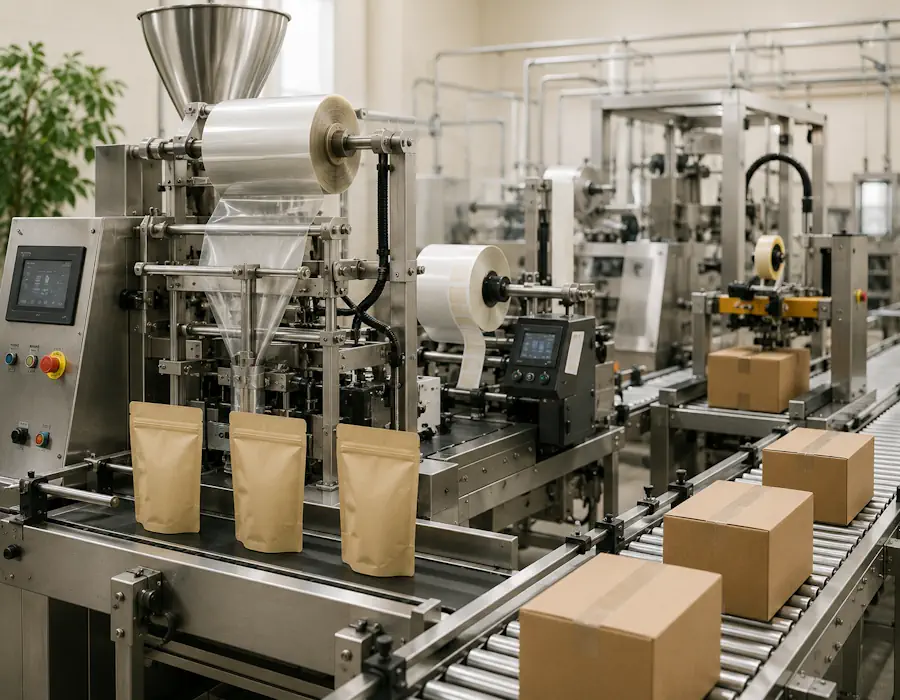
Manual and semi-manual equipment covers tools like tabletop heat sealers, manual vacuum sealers, and hand-crank fillers. It makes sense at lower volume, where labor cost stays below the capital cost of automation and flexibility to switch between product formats matters more than raw speed. Semi-automated equipment — a tabletop form-fill-seal machine, a semi-automatic tray sealer — becomes worthwhile once volume climbs enough that consistent labor cost starts to outweigh the equipment investment, typically somewhere in the low thousands of units per day, though this varies significantly by product and margin. Fully automated lines integrate filling, sealing, and often labeling into one continuous process, and generally only make financial sense at higher volumes where the equipment cost is justified by labor savings and throughput over a realistic payback period, usually evaluated in years rather than months.
The most common costly mistake in this space isn’t buying the wrong machine — it’s buying automation before volume actually justifies it, which ties up capital and often locks a producer into a format that’s harder to change than a more flexible manual or semi-automated setup would have been.
Common Equipment Types by Function
Form-fill-seal machines form a package from a roll of film, fill it with product, and seal it in one continuous process — the backbone of high-volume packaging for snacks, coffee, and similar dry and semi-dry products. Vacuum sealers remove air before sealing, extending shelf life for products sensitive to oxygen exposure, and range from countertop units for small operations to industrial in-line systems. Tray and blister sealers apply a film lid to a pre-formed tray or cavity, common in food service, produce, and pharmaceutical packaging. Filling equipment, built around volumetric or weight-based dosing, handles liquids and powders that don’t fit the flow-wrap mechanics used for solid products. Labeling and coding equipment applies labels, dates, and batch codes, often integrated into a larger line rather than operated as a standalone step.
Robotic and Automated Packaging
Robotic packaging equipment — automated pick-and-place systems, robotic case packers, palletizing robots — has grown fast in the packaging industry, driven largely by labor cost pressure and improving robotics cost-effectiveness at smaller scales than were previously viable. Robotic systems are strongest for repetitive, high-volume tasks with consistent product geometry; they’re a poorer fit for operations with frequent product changeovers or highly variable packaging formats, where the flexibility of manual or semi-automated processes still wins out. As with automation generally, the decision comes down to whether volume and consistency justify the upfront investment, not whether the technology itself is impressive.
Industry-Specific Equipment
Food packaging equipment, which we cover for small producers specifically in a dedicated guide, spans everything from simple heat sealers to full form-fill-seal lines, with specific variants built for frozen, liquid, and modified-atmosphere packaging needs. Pharmaceutical packaging equipment, including blister packaging machines, carries additional validation requirements beyond the mechanical function itself, since equipment changes in regulated industries often require regulatory revalidation. Coffee packaging equipment specifically needs to handle the degassing valve installation that’s become close to standard in retail coffee bags, a specialized step general-purpose equipment doesn’t handle.
New vs. Used Equipment
Used equipment is a genuine option, particularly for producers testing a new line or product before committing to new capital equipment. It costs meaningfully less upfront but carries more uncertainty around remaining service life and may lack current safety or efficiency features compared to new models. New equipment carries manufacturer support and warranty coverage at a materially higher price point, which tends to matter more for equipment central to daily production than for occasional or experimental use, where the lower cost of used equipment is easier to justify.
Evaluating a Packaging Equipment Manufacturer
A few things matter more than brand recognition when evaluating a manufacturer or supplier. Support and service availability in your region affects real uptime far more than most buyers expect going in, since equipment downtime without local service support can halt production entirely. Changeover time and flexibility, meaning how quickly a machine can switch between product formats, matters more for operations with variable product lines than raw throughput specs suggest on paper. And total cost of ownership, including maintenance, consumables, and realistic service life, is a more useful comparison than sticker price alone, since a cheaper machine with expensive or hard-to-source parts often costs more over its working life.
Frequently Asked Questions
What packaging equipment does a small business need to start?
Most small producers start with manual or semi-manual equipment — a tabletop heat sealer or basic vacuum sealer — and move to semi-automated equipment once volume consistently justifies the investment.
How much does packaging machinery cost?
It varies enormously by automation level, from a few hundred dollars for basic manual equipment to well into six figures for fully automated production lines, which is why matching equipment to actual current volume matters more than buying for anticipated future volume.
Is robotic packaging equipment worth it for a small operation?
Usually not yet — robotic systems are strongest for high-volume, consistent, repetitive tasks, and the upfront cost is harder to justify at smaller scale or with frequent product changeovers, where manual or semi-automated equipment remains more flexible and cost-effective.
Should I buy new or used packaging equipment?
For equipment central to daily production, new equipment’s warranty and support typically outweigh the upfront savings of used. For testing a new product line or occasional use, used equipment can be a reasonable way to reduce risk while validating demand.