

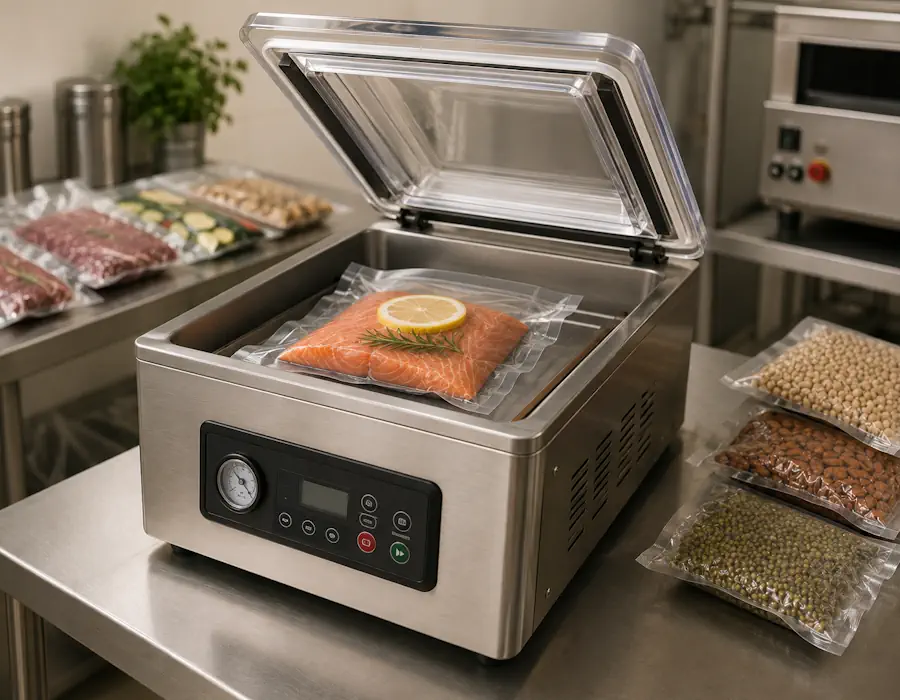
Vacuum packaging machines remove air from a package before sealing it, which extends shelf life by cutting off the oxygen that drives spoilage and rancidity, and reduces package volume by compressing the contents against the film. It’s one of the equipment types most small and growing food producers encounter first, and the category ranges from countertop units suited to a small kitchen operation to full industrial chamber machines running continuous production lines, and matching the right tier to actual volume is most of the buying decision.
How Vacuum Sealing Actually Works
The process removes air from around a product, then heat-seals the package while the vacuum holds, so no air re-enters before the seal sets. Beyond extending shelf life by limiting oxidation, this also compresses flexible packaging tightly around its contents, which is why vacuum-sealed products take up less shelf and shipping space than the same product in loosely filled packaging — a secondary benefit that matters for anything shipped at volume, not just a shelf-life consideration.
External vs. Chamber Vacuum Sealers
This is the main structural distinction in the category, and it drives most of the price and use-case differences buyers encounter. External vacuum sealers draw air out through the open end of a bag while the rest stays outside the machine, and they’re generally lower cost and suited to dry or solid products, but they struggle with liquids, which tend to get pulled out along with the air. Chamber vacuum sealers place the entire product and bag inside a sealed chamber, then vacuum the whole chamber before sealing, which handles liquids and moist products cleanly since nothing is being pulled through an open bag opening — the tradeoff is a meaningfully higher cost and larger equipment footprint.
Double chamber machines run two sealing chambers in parallel, letting one load while the other seals, which increases throughput for higher-volume operations without needing to step up to a fully automated in-line system.
Matching a Vacuum Sealer to Your Operation
A basic countertop external sealer suits low-volume, dry or solid products, and is the appropriate starting point for a small food business or home-based operation testing product-market fit before investing further. A commercial external or single-chamber sealer fits a growing operation with moderate, consistent volume and products that don’t heavily involve liquids. An industrial or double-chamber machine is justified once volume is high enough and consistent enough to demand continuous operation, or once product mix includes liquids or moist products that external sealers handle poorly.
Buying a chamber machine before volume or product mix actually requires one is a common overspend — for many small producers, a commercial-grade external sealer handles real production needs well past the point where a hobbyist unit would fail, without the cost jump of a full chamber system.
Frequently Asked Questions
What's the difference between a vacuum sealer and a vacuum packaging machine?
They’re generally the same thing — “vacuum sealer” is more common in consumer and small-business contexts, while “vacuum packaging machine” is used more often for commercial and industrial equipment, though the terms overlap significantly.
Can vacuum sealers handle liquids?
External vacuum sealers generally struggle with liquids, since the vacuum process can pull liquid out along with the air. Chamber vacuum sealers handle liquids and moist products more reliably, since the whole chamber is vacuumed rather than air being drawn through an open bag.
How much does an industrial vacuum packaging machine cost?
It varies widely by chamber size, automation level, and throughput, generally running from a few thousand dollars for smaller commercial units to well beyond that for larger double-chamber or fully automated systems.
Do I need a chamber vacuum sealer for a small food business?
Not necessarily — a commercial external sealer often handles dry and solid product needs well for smaller operations, with chamber systems becoming worthwhile mainly once liquid products or higher, more consistent volume are involved.