

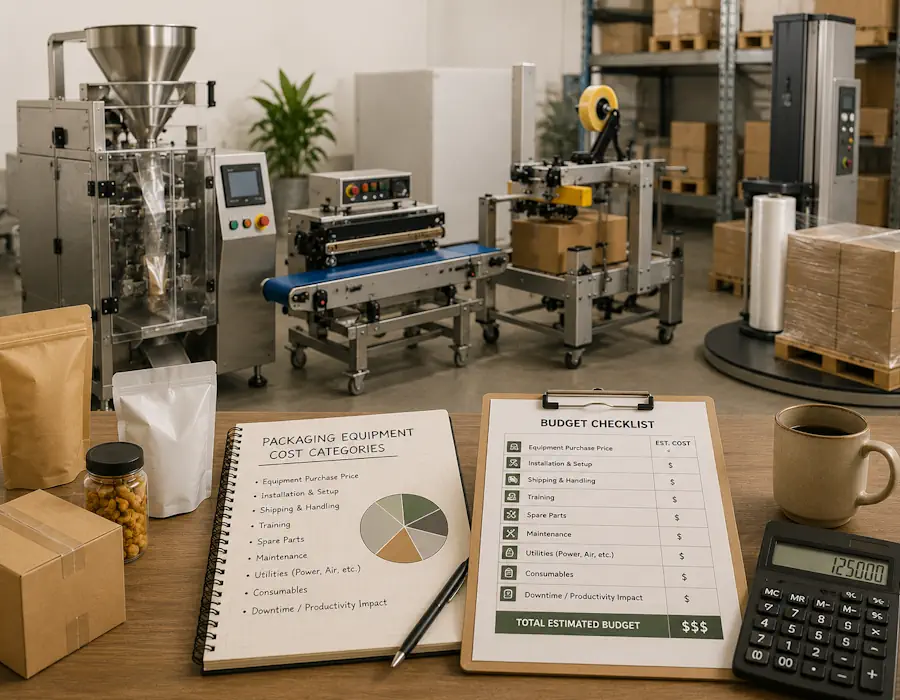
Packaging equipment pricing varies too widely to quote a single number that’s useful — a tabletop sealer and a fully automated form-fill-seal line aren’t remotely comparable purchases, and even within one equipment category, price depends heavily on throughput, automation level, and whether you’re buying new or used. What’s more useful than a specific price range is understanding the actual cost components involved, since the purchase price alone rarely reflects the full budget a piece of equipment requires.
The Real Cost Components Beyond Purchase Price
Purchase price is only the starting point, and treating it as the full budget is one of the more common planning mistakes. Installation and setup, particularly for larger or automated equipment, often requires facility modifications, electrical work, or specialized installation labor that isn’t included in the equipment quote itself. Training, for staff operating and maintaining new equipment, takes real time and sometimes a formal training cost from the manufacturer, and is easy to underbudget for. Ongoing maintenance and consumables — replacement parts, film or sealing materials specific to a machine, routine service — represent a real recurring cost that should factor into any total cost of ownership comparison between options. And downtime risk, meaning how quickly a machine can be repaired if it fails, depends heavily on local service and parts availability, which varies significantly by manufacturer and region.
A cheaper machine with poor local service support or hard-to-source parts frequently costs more over its working life than a pricier option with strong regional support — this is why total cost of ownership, not sticker price, is the more useful comparison.
Manufacturer, Supplier, or Used: Where to Buy
Buying direct from a manufacturer generally offers the most customization and direct technical support, but often at a higher price point and with less flexibility on order size, particularly for smaller or one-off purchases. Buying through a supplier or distributor can offer more flexibility and sometimes faster turnaround, especially for standard, non-customized equipment, though with less direct manufacturer relationship for technical issues down the line. Buying used equipment, worth considering particularly when testing a new product line or process before committing to new capital equipment, costs meaningfully less upfront but carries more uncertainty around remaining service life and may lack current safety or efficiency features.
Local vs. National vs. International Manufacturers
This tradeoff matters more for equipment than for most other packaging purchases, because service and repair turnaround directly affects production uptime. Local or regional manufacturers and suppliers typically offer faster service response and easier communication for repairs, which matters more the more central a piece of equipment is to daily production. National manufacturers often provide a middle ground on pricing and service reach, useful once a local option can’t meet capacity or capability needs. International manufacturers, particularly for highly specialized or high-throughput equipment, can offer strong pricing and capability, but parts and service turnaround time need to be weighed carefully against that — a machine that’s cheaper to buy but takes weeks to get parts for during a breakdown can cost far more in lost production than it saved upfront.
Frequently Asked Questions
How much does packaging equipment cost?
It varies enormously by automation level and throughput, from a few hundred dollars for basic manual equipment to well into six figures for fully automated production lines — the specific range depends heavily on your product and volume requirements.
Is it cheaper to buy from a manufacturer or a supplier?
It depends on the equipment and order size — manufacturers often offer better pricing and customization at higher volumes, while suppliers or distributors can be more flexible and faster for standard equipment in smaller quantities.
What should I budget for beyond the equipment purchase price?
Installation, staff training, ongoing maintenance and consumables, and the cost of potential downtime based on local service and parts availability all factor into the real total cost of a piece of packaging equipment.
Is buying used packaging equipment a good way to reduce cost?
It can be, particularly for testing a new product line before committing to new capital equipment, though it carries more uncertainty around remaining service life and may lack current safety or efficiency features compared to new equipment.