
Food packaging machines aren’t a single product category — the right machine depends heavily on what you’re packaging, since frozen, dry, and liquid food each place genuinely different demands on equipment. Rather than a generic list of machine types, the more useful starting point is matching equipment to your specific product category, since that’s what actually narrows the decision.
Machines by Food Category
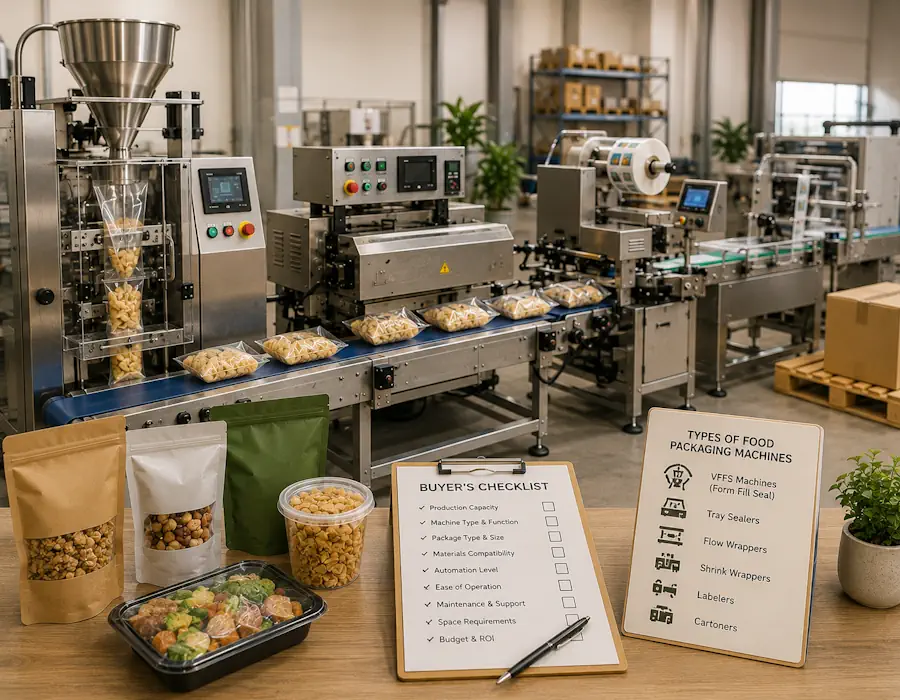
Dry food packaging machines, handling products like grains, snacks, and powders, are generally the least demanding category to equip for — standard form-fill-seal machines handle most dry product packaging without needing specialized temperature or moisture-handling features. Frozen food packaging machines need to perform reliably at low operating temperatures and handle packaging materials that stay flexible and seal-intact through the temperature swing between freezer and counter, which is a real mechanical difference from equipment built for room-temperature product. Snack food packaging machines are typically high-speed form-fill-seal systems, since snack production usually runs at higher volume and lower per-unit value than more specialized categories, making throughput speed a bigger factor than for lower-volume, higher-value products. Pet food packaging machines, whether for kibble or wet food, need to handle either heavy-duty flexible bags with strong seal integrity for dry kibble or filling and sealing equipment similar to human liquid food products for wet pet food — a distinction covered in more depth in our pet food packaging guide.
Commercial vs. Industrial Equipment
This distinction matters as much as product category for narrowing down real options. Commercial food packaging machines are sized and priced for smaller operations — bakeries, small manufacturers, co-packers running moderate volume — generally offering less throughput than industrial equipment but at a meaningfully lower cost and footprint. Industrial food packaging machines are built for continuous, high-volume production, typically integrated into a larger production line rather than operated as standalone equipment, and represent a significantly higher investment that only makes sense once volume is consistently high enough to justify it.
Most food producers move from commercial to industrial equipment as volume grows, rather than starting with industrial-scale equipment before production justifies it — a progression that mirrors the volume-matching framework in our food packaging equipment guide — and jumping straight to industrial equipment ahead of real demand is one of the more common overinvestment mistakes in early-stage food production.
Automated vs. Manual Options
Within any of the categories above, automation level is a separate decision, generally following the same volume-based logic that applies to packaging equipment broadly: automated food packaging machines make sense once volume and consistency are high enough to justify the higher upfront cost through labor savings, while manual or semi-automated equipment remains the more practical choice for lower or more variable volume.
Frequently Asked Questions
What machine do I need to package snack food?
Snack food packaging typically uses high-speed form-fill-seal machines, since snack production usually runs at higher volume than more specialized food categories, making throughput a bigger factor in equipment choice.
Do frozen food products need special packaging machines?
Yes — frozen food packaging equipment needs to operate reliably at low temperatures and handle materials that stay flexible and seal-intact through the freezer-to-counter temperature swing, which isn’t a requirement for room-temperature product equipment.
What's the difference between commercial and industrial food packaging machines?
Commercial machines are sized and priced for smaller operations at lower throughput, while industrial machines are built for continuous, high-volume production, typically at a significantly higher cost and usually integrated into a larger line.
Should I buy an automated food packaging machine?
It depends on your volume and consistency — automated equipment tends to pay off once volume is high and predictable enough for labor savings to outweigh the higher upfront cost, similar to the automation decision for packaging equipment generally.