

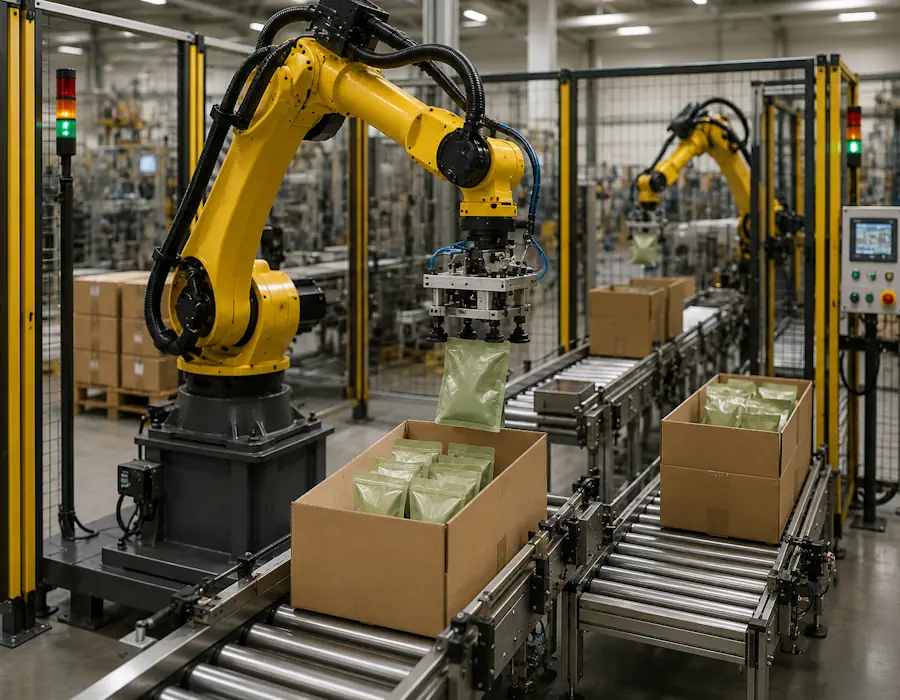
Robotic packaging has moved well past the large-scale, high-capital-cost systems that once limited it to major manufacturers — smaller, more affordable robotic units have brought real automation within reach of mid-sized operations over the past several years. That said, robotics still isn’t the right fit for every packaging operation, and understanding where it genuinely earns its cost, versus where conventional automation or manual processes remain more practical, matters more than the technology itself.
What Robotic Packaging Equipment Actually Does
Pick-and-place robots handle repetitive picking and placing tasks — moving products from one point in a line to another, often into cases or onto pallets — and are the most common entry point into packaging robotics, since the task itself is well-suited to robotic consistency and speed. Case packing robots load finished products into shipping cases, a role that’s traditionally been physically demanding, repetitive manual labor, making it one of the strongest cost-justification cases for robotics adoption. Palletizing robots stack cases onto pallets in optimized patterns, another traditionally labor-intensive, injury-prone task that robotics handles well at consistent volume. Collaborative robots, or cobots, work alongside human operators rather than fully replacing a station, offering a lower-cost, more flexible entry point than a fully robotic line for operations not ready for complete automation.
Where Robotics Makes Sense
Robotic packaging is strongest for repetitive, high-volume tasks with consistent product geometry — the more uniform and predictable a product and its packaging, the better robotics performs relative to its cost. It’s a notably poorer fit for operations with frequent product changeovers or highly variable packaging formats, since reprogramming or retooling a robotic system for a new product configuration takes real time and expertise that manual or semi-automated processes don’t require to the same degree. This is why robotics has grown fastest in end-of-line applications like case packing and palletizing — these tasks tend to be more uniform across product variations than earlier packaging steps like filling or primary sealing.
Cost and Accessibility
The barrier to entry for robotic packaging has dropped meaningfully as smaller, more affordable robotic units and collaborative robots have entered the market, but the investment still generally requires higher, more consistent volume to justify than conventional semi-automated equipment. The decision follows the same underlying logic as packaging automation generally: it comes down to whether the labor cost robotics eliminates, evaluated over a realistic payback period, actually outweighs the equipment investment and integration cost for your specific volume and consistency profile.
Food Packaging Robotics
Food packaging robotics carries the same additional considerations that apply to food packaging automation more broadly — sanitation and washdown requirements shape what equipment is actually viable, and food product variability, since food items often vary more in size and shape than manufactured goods, can make robotic handling less reliable than in more uniform industrial applications. This is part of why robotic adoption in food packaging has concentrated in more uniform tasks like case packing rather than earlier, more variable steps.
Frequently Asked Questions
What is robotic packaging used for?
Common applications include pick-and-place tasks, case packing, and palletizing — generally repetitive, physically demanding tasks with consistent product geometry, where robotics offers strong labor savings and consistency.
Is robotic packaging affordable for smaller operations?
It’s become more accessible with smaller, lower-cost robotic units and collaborative robots, but it still generally requires higher and more consistent volume than conventional semi-automated equipment to justify the investment.
What's the difference between a robot and a cobot in packaging?
A cobot, or collaborative robot, works alongside human operators at a shared station, while a fully robotic system typically operates independently, often behind safety guarding, without a person working directly alongside it.
Does robotic packaging work well for food products?
It depends on the task — food packaging robotics has grown fastest in more uniform applications like case packing, while earlier, more variable steps remain more challenging for robotics due to natural variation in food product size and shape.