
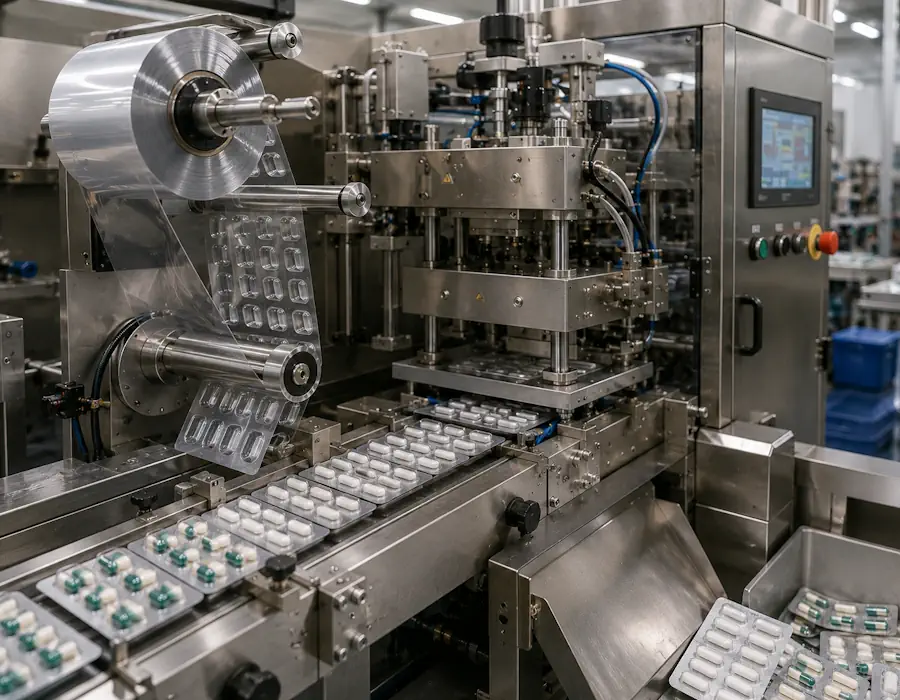
Blister packaging machines form and seal the individual pockets — the “blisters” — that hold pills, capsules, and small consumer goods behind a sealed cavity, typically backed by foil or card. It’s one of the more specialized categories of packaging machinery, largely because pharmaceutical blister packaging in particular carries validation requirements well beyond the mechanical process itself.
How Blister Packaging Machines Work
The process generally follows two core steps regardless of scale. First, a sheet of plastic film is heated and formed into cavities, typically through thermoforming, where heated plastic is shaped over or into a mold to create the pocket shape, or cold forming, which shapes a laminated foil material without heat, offering a stronger moisture and oxygen barrier at a higher material cost. The product — a pill, capsule, or small item — is then placed into each formed cavity, and a backing material, usually foil or card, is sealed over the top to close each pocket individually.
Thermoforming is the more common and generally lower-cost method, suited to products without extreme moisture-sensitivity requirements. Cold forming is used where barrier performance matters more, since it can achieve better protection against moisture and oxygen than thermoformed film, which is part of why it shows up more often in pharmaceutical applications with sensitive formulations.
Pharmaceutical Blister Packaging Machines Specifically
Pharmaceutical use represents a meaningful share of blister packaging demand, and it comes with requirements beyond the general packaging process. Validation is required for the equipment and process itself in most regulated markets, meaning a change to the machine or its settings can trigger a need for revalidation, not just a mechanical adjustment — a requirement we cover in the context of primary packaging more broadly in our pharmaceutical packaging guide. Serialization and track-and-trace features, printing unique codes on individual blister cards for supply chain tracking, are increasingly standard equipment features in pharmaceutical blister lines specifically, driven by growing anti-counterfeiting and traceability regulations. Child-resistant and tamper-evident features are often built into the blister design and sealing process itself, not added afterward, which affects both machine specification and the packaging materials used.
Machine Scale: Small vs. Industrial
Small blister packaging machines suit lower-volume production — nutraceutical startups, smaller pharmaceutical runs, or non-pharmaceutical consumer goods needing blister packaging for retail display. Industrial blister lines integrate forming, filling, and sealing into a continuous high-speed process, appropriate once volume is consistent and high enough to justify the higher equipment cost and, for pharmaceutical applications, the validation investment that comes with a larger production system.
Frequently Asked Questions
What is the difference between thermoforming and cold forming for blister packaging?
Thermoforming uses heat to shape plastic film into cavities and is generally lower cost, while cold forming shapes a laminated foil material without heat, offering stronger moisture and oxygen barrier performance at a higher material cost.
Why does pharmaceutical blister packaging need machine validation?
Regulatory requirements in most markets require that pharmaceutical packaging processes be validated for consistency and safety, meaning changes to the equipment or its settings can trigger a need to revalidate the process, not just a mechanical adjustment.
Can small businesses buy blister packaging machines?
Yes — smaller blister packaging machines exist for lower-volume production, suited to startups or smaller runs, as opposed to industrial lines built for continuous, high-volume pharmaceutical or consumer goods production.
What products use blister packaging besides pharmaceuticals?
Blister packaging is also common for small consumer goods sold at retail — batteries, small electronics accessories, and hardware items, among others — where the visible cavity supports retail display alongside protection.