
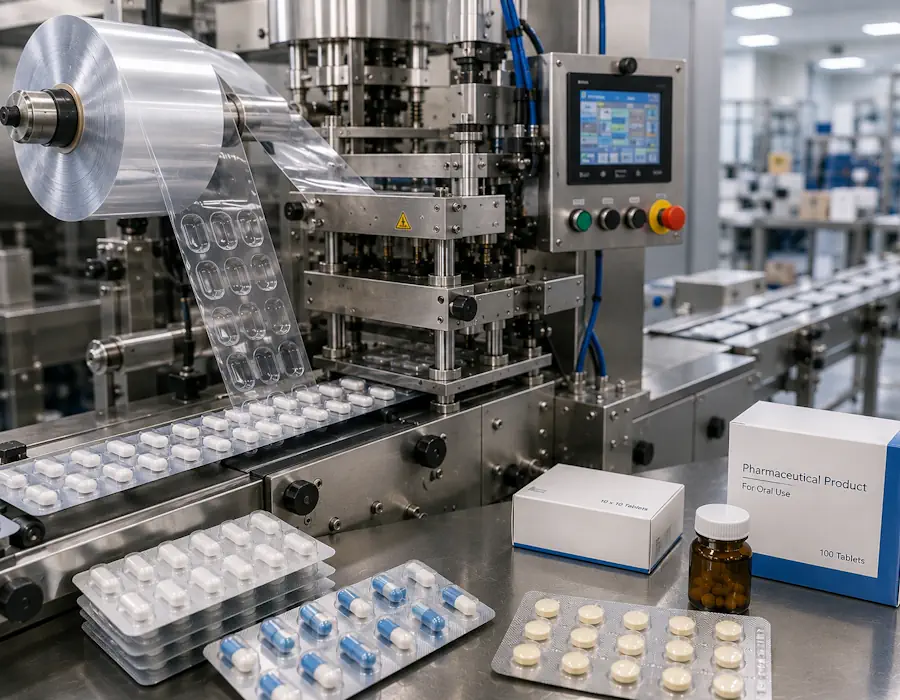
Blister packaging — individual sealed cavities holding a pill, capsule, or small item, typically backed by foil or card — has remained the dominant format for solid oral medications for decades despite plenty of packaging innovation elsewhere, and the reasons come down to a combination of patient safety, cost, and manufacturing practicality that’s genuinely hard to replicate with an alternative format. For how these packages are actually produced, see our guide to blister packaging machines; this page focuses on the format itself and why it’s chosen in the first place.
Why Blister Packaging Dominates for Medications
Individual dose isolation is the core advantage: each dose sits in its own sealed cavity, isolated from moisture, oxygen, and contamination until the moment it’s used, which matters enormously for medications sensitive to environmental exposure. Tamper-evidence is essentially built into the format — a punctured or opened blister is immediately visible, which is harder to achieve as clearly with a bottle. Dosing compliance support, since blister cards are often printed with day-of-week or time-of-day labeling, helps patients track whether a dose has been taken, a genuine clinical benefit beyond pure packaging function. And manufacturing cost at scale remains low relative to the protection and functionality delivered, which matters across an industry producing enormous volumes of solid oral doses.
Materials: Foil vs. Plastic Blister Packaging
The backing material is one of the most consequential material choices in blister packaging. Foil backing, typically aluminum, offers superior barrier protection against moisture and oxygen compared to plastic-backed alternatives, and is standard for moisture-sensitive medications. Plastic (PVC or similar) backing, often clear, allows the contents to be visible, which matters for retail and consumer applications more than for prescription medications, and generally costs less than foil at the expense of some barrier performance. The forming material — the plastic that creates the actual cavity — also varies, with cold-formed foil laminates offering the strongest barrier protection for the most sensitive products, at a higher material cost than standard thermoformed plastic.
Blister Packaging Beyond Pharmaceuticals
While pharmaceuticals remain blister packaging’s largest application, the format shows up meaningfully elsewhere. Medical devices use blister packaging extensively for smaller, single-use items — needles, surgical instruments, diagnostic test components — valued for the same contamination isolation and tamper-evidence that makes it useful for medication. Retail and consumer goods use blister and clamshell packaging (a related but distinct format, typically larger and often fully enclosing a product rather than using individual small cavities) for small hardware, electronics accessories, and toys, primarily for theft deterrence and retail display rather than the barrier and dosing functions that drive pharmaceutical use.
Custom Blister Packaging
Custom blister packaging — specific cavity shapes, card printing, branding — is common in both pharmaceutical and retail applications, though the design constraints differ significantly between them. Pharmaceutical blister design has to work within validated, often standardized formats due to regulatory requirements, limiting how much customization is practical without triggering additional regulatory review. Retail blister and clamshell design has far more creative latitude, since it isn’t subject to the same validation requirements, making it a more flexible design space for branding and shelf presentation.
Frequently Asked Questions
What is blister packaging used for?
Blister packaging is primarily used for solid oral medications like tablets and capsules, medical devices requiring individual sterile isolation, and retail consumer goods needing theft-deterrent, visible packaging.
What's the difference between blister packaging and clamshell packaging?
Blister packaging typically refers to individual small cavities, often arranged in a grid on a card, while clamshell packaging is usually a larger format that fully encloses a single product between two connected halves — both use similar forming processes but serve somewhat different purposes.
Why does pharmaceutical blister packaging use foil instead of clear plastic?
Foil offers stronger barrier protection against moisture and oxygen than plastic backing, which matters for medications sensitive to environmental exposure, even though it means the contents aren’t visible the way a clear plastic backing would allow.
Can blister packaging be customized for a specific product?
Yes, though the flexibility differs by application — pharmaceutical blister design is constrained by regulatory validation requirements, while retail and consumer blister or clamshell packaging generally has much more design freedom.