

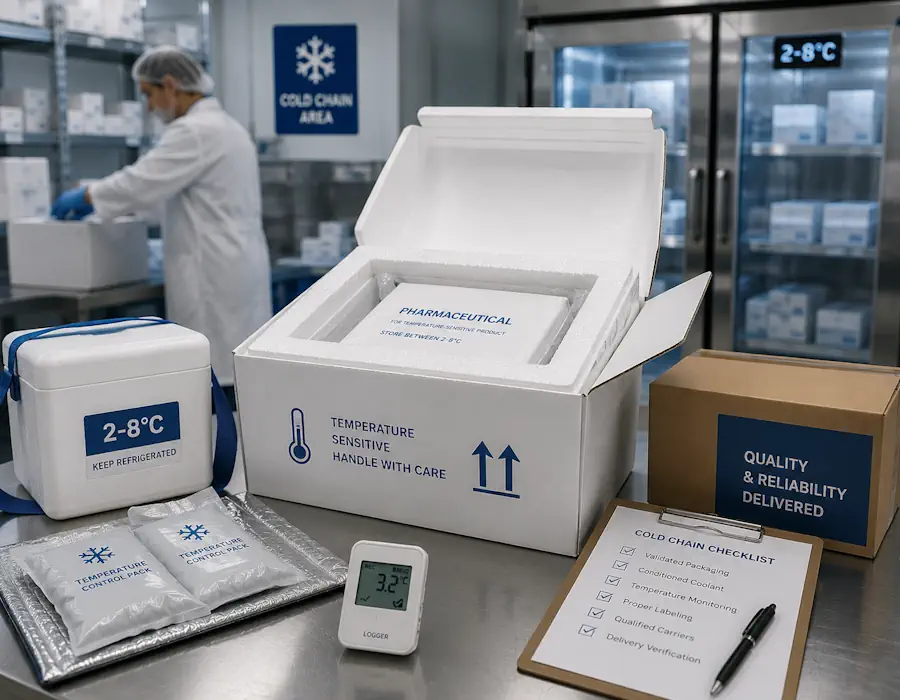
Cold chain packaging keeps temperature-sensitive pharmaceuticals — vaccines, biologics, certain injectables — within a required temperature range from the point of manufacture through to the point of use, often across days of transit and multiple handoffs between facilities. It’s one of the more demanding applications within pharmaceutical packaging broadly, and unlike most packaging categories where a failure shows up as damaged or unappealing product, a cold chain failure can render a medication unsafe or ineffective without any visible sign that anything went wrong, which is what makes this category unusually unforgiving of design or process shortcuts.
Why Cold Chain Packaging Is So Demanding
Many biologics and vaccines are only stable within a narrow temperature band, often refrigerated or even frozen, and even brief excursions outside that range can degrade the product without any visible change to the packaging or product appearance. This means cold chain packaging isn’t just about keeping something cold — it’s about proving, with documentation, that it stayed within range for the entire journey, since a shipment that can’t demonstrate continuous compliance may need to be discarded even if it’s likely still effective. That validation and documentation burden is a real part of the packaging system, not an add-on to it.
Passive vs. Active Cold Chain Packaging
This is the primary technology distinction in the category. Passive systems rely on insulation and pre-conditioned materials — gel packs, phase-change materials, or dry ice — to maintain temperature for a defined duration without any powered component, offering lower cost and simpler logistics at the expense of a fixed, sometimes shorter window of protection. Active systems use powered refrigeration or heating within the shipping container itself, offering much longer protection windows and more precise temperature control, but at meaningfully higher cost and with more points of potential mechanical failure.
Passive systems dominate for shorter transit times and smaller shipment volumes, while active systems become more common for longer international shipments or larger volumes where the higher cost is justified by the product value and the length of the journey.
Monitoring and Validation
Temperature monitoring is inseparable from cold chain packaging in a way it isn’t for most other categories — data loggers or real-time sensors record temperature throughout transit, creating the documentation needed to confirm a shipment stayed within its required range. This monitoring data is often what determines whether a shipment is usable on arrival, independent of whether the product looks or tests fine, since regulatory and safety protocols generally require documented compliance rather than after-the-fact product testing alone.
Reusable and Sustainable Cold Chain Packaging
Cold chain packaging has historically generated significant single-use waste — insulated containers and gel packs designed for one shipment and then discarded — which has driven real growth in reusable systems designed to be returned, reconditioned, and reused across multiple shipments. Reusable systems carry a higher upfront cost but can offer meaningfully lower cost per shipment over many cycles, along with a genuinely stronger sustainability profile than single-use alternatives, provided the reverse logistics (getting containers back for reuse) are practical for a given distribution network. This reverse logistics requirement is the main practical constraint limiting reusable adoption — it works well for closed, predictable distribution loops and less well for long, one-directional international shipments.
Frequently Asked Questions
What is cold chain packaging?
Cold chain packaging refers to insulated and temperature-controlled packaging systems designed to keep temperature-sensitive products, particularly pharmaceuticals like vaccines and biologics, within a required temperature range throughout shipping and storage.
What's the difference between passive and active cold chain packaging?
Passive systems use insulation and pre-conditioned materials like gel packs to maintain temperature without power, suited to shorter transit times. Active systems use powered refrigeration for longer, more precise temperature control at a higher cost.
Why is temperature monitoring required for cold chain shipments?
Many temperature-sensitive pharmaceuticals can degrade without any visible change, so monitoring data provides the documentation needed to confirm a shipment stayed within its required range, which is often required for regulatory and safety compliance regardless of how the product appears on arrival.
Is reusable cold chain packaging practical for all pharmaceutical shipments?
Not always — reusable systems work best for closed, predictable distribution loops where containers can realistically be returned and reconditioned, and are less practical for long, one-directional international shipments where return logistics are difficult.