

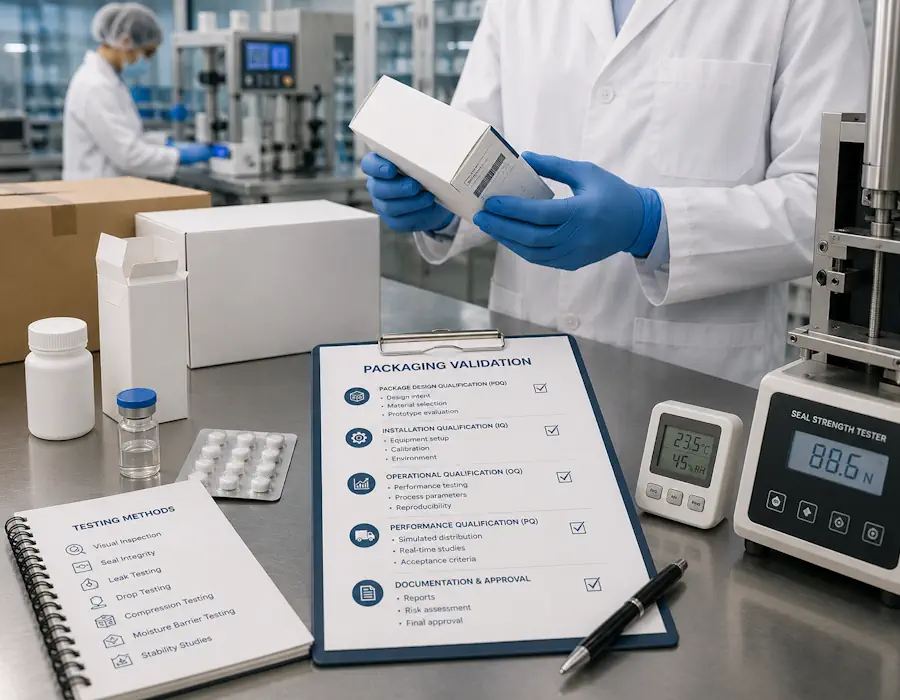
Validation comes up throughout pharmaceutical and medical device packaging — we’ve referenced it in the context of container-closure systems, sterile barrier testing, and contract packaging relationships — but the process itself is worth explaining directly, since it’s easy to treat as an abstract regulatory requirement rather than the specific, structured testing process it actually is.
What Packaging Validation Actually Confirms
At its core, packaging validation demonstrates that a specific packaging system, produced by a specific process, consistently performs as intended — protecting the product, maintaining sterility or stability, and functioning correctly over its intended shelf life. This isn’t a one-time inspection of a sample package; it’s evidence that the process itself, run repeatedly under real production conditions, reliably produces packaging meeting the required standard. That distinction matters because it’s also why validation has to be repeated when something changes — a single well-performing sample doesn’t validate a process if that process isn’t shown to be consistent.
The Core Components of a Validation Protocol
Validation protocols generally follow a structured sequence, though specific requirements vary by product type and regulatory jurisdiction. Installation qualification confirms equipment is installed and configured correctly according to specifications, before any product runs through it. Operational qualification confirms the equipment operates correctly across its intended range of settings, typically tested without a live product yet. Performance qualification confirms the complete process, running actual product through the actual packaging system under real production conditions, consistently produces packaging meeting all required specifications. Beyond these three stages, stability testing evaluates how the packaged product performs over its intended shelf life under various storage conditions, and seal integrity or barrier testing, particularly relevant for sterile barrier systems and container-closure systems, confirms the specific protective function required for that packaging type.
Validation for Medical Devices vs. Pharmaceuticals
Both categories require rigorous validation, but the specific standards and focus differ somewhat. Medical device packaging validation is typically governed by ISO 11607, which we cover in the context of sterile barrier systems, focusing heavily on maintaining sterility until the point of use. Pharmaceutical packaging validation tends to focus more on container-closure integrity and stability of the specific drug formulation over its shelf life, since the primary risk being managed is product degradation or contamination affecting the drug itself rather than sterility of a device.
When Revalidation Is Required
This is one of the more consequential practical aspects of working within a validated packaging system. Any change to the packaging materials, the equipment used to produce it, or the manufacturing process generally triggers a need for at least partial revalidation, and in many cases requires updating the underlying regulatory filing before the change can be implemented. This is why packaging changes in pharmaceutical and medical device companies move more slowly and deliberately than in most other industries — it’s not bureaucratic caution for its own sake, it’s a direct consequence of how validation and regulatory approval are structured together.
Frequently Asked Questions
What is packaging validation?
Packaging validation is the process of demonstrating that a specific packaging system, produced by a specific process, consistently protects and maintains a product as required, typically through installation, operational, and performance qualification testing.
Does packaging validation need to be repeated if something changes?
Generally yes — changes to packaging materials, equipment, or the manufacturing process typically require at least partial revalidation, and often require updating the associated regulatory filing before the change can be implemented.
What's the difference between validation for medical devices and pharmaceuticals?
Medical device packaging validation, generally governed by ISO 11607, focuses heavily on maintaining sterility until use, while pharmaceutical packaging validation focuses more on container-closure integrity and drug product stability over shelf life.
Who is responsible for packaging validation — the manufacturer or the packaging supplier?
Responsibility is often shared, but the company holding the regulatory approval for the product is ultimately accountable for ensuring validation is complete and current, even when packaging materials or processes involve outside suppliers or contract packagers.