

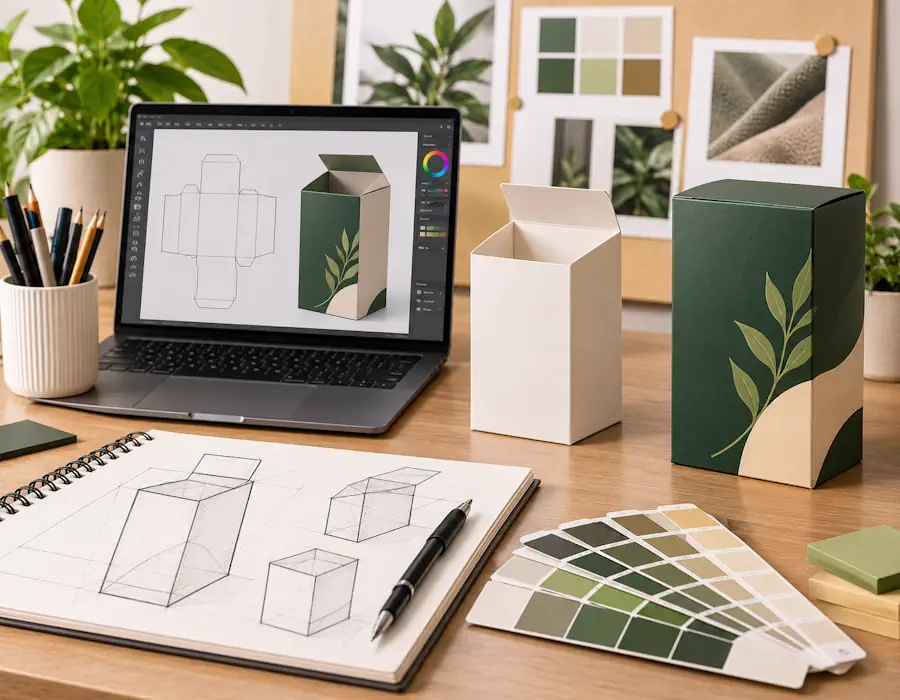
Product packaging design has a real, fairly consistent process behind it, whether it’s run by an in-house team, an agency, or a freelance designer — the sequence matters because skipping or rushing any single step tends to surface as an expensive problem later, usually right around the point of production rather than earlier when it would be cheap to fix.
Step 1: Define the Brief
Before any visual work starts, a clear brief needs to answer a handful of specific questions: what the product is and who buys it, what information the packaging is legally required to carry, what budget and production constraints already exist (a target unit cost, an existing material or structure decision), and what success actually looks like — better shelf stand-out, clearer communication, lower packaging cost, or some combination. A vague brief is one of the most common causes of a design process that drags on through too many rounds of revision, since without clear success criteria, feedback tends to be subjective and inconsistent round after round.
Step 2: Research and Concept Development
This stage typically starts with a competitive audit — seeing what similar products actually look like on shelf or online, both to understand category conventions and to identify where genuine differentiation is possible. From there, concept development usually produces multiple distinct visual directions rather than a single refined option, giving real choice before committing further design time and cost to one direction. Showing only one polished concept at this stage tends to produce weaker feedback, since there’s nothing to compare it against — multiple rougher directions generate more useful, comparative input.
Step 3: Refine the Chosen Direction
Once a direction is selected, this stage resolves it in real detail: exact colors (specified in a way that will translate accurately to print, not just on-screen), typography, layout hierarchy, and how the graphic design interacts with the actual physical structure it will be printed or applied to. This is also typically where required regulatory and informational content gets integrated properly, rather than treated as an afterthought layered onto an otherwise finished design.
Step 4: Prototype and Test
Physical prototypes matter more in packaging design than in many other design disciplines, because screen renderings are genuinely unreliable for judging real-world color, material texture, and scale — a design that looks perfect on a monitor can read completely differently printed on the actual substrate at actual size. Testing at this stage can range from informal internal review to more structured shelf-impact testing, but the underlying goal is the same: catching a problem here, before a full production run, is dramatically cheaper than discovering it after.
Step 5: Prepare Production Files
The final stage translates the approved design into the specific technical files a printer or manufacturer needs — accurate dielines, color specifications in the correct format for the printing process being used, and bleed and safety margins that account for real-world production tolerances. Files prepared without production-specific knowledge are one of the more common sources of costly delays and reprints at this stage, which is part of why structural and production file work benefits from either dedicated expertise or close collaboration with the manufacturer who will actually produce the packaging.
Common Mistakes That Extend the Process
A few patterns show up repeatedly in projects that take longer or cost more than expected. Skipping the brief stage and jumping straight to visual concepts tends to produce more revision rounds later, since there was never a clear standard to evaluate concepts against. Relying entirely on screen review without a physical prototype risks discovering color, scale, or material problems only after a full production run has already been committed. And treating structural and graphic design as sequential rather than parallel work — finishing the graphics first, then trying to fit them onto a separately-decided structure — routinely produces designs that don’t translate cleanly onto the actual package shape.
Frequently Asked Questions
How long does product packaging design typically take?
It varies significantly by complexity, but a straightforward label or flat-panel redesign might take a few weeks, while a fully custom structural package with multiple rounds of prototyping can take several months from brief to production-ready files.
What's the difference between a design concept and a finished design?
A concept is an early-stage visual direction meant for comparison and feedback, not production; a finished design has been fully resolved in detail, tested, and translated into production-ready technical files.
Why is physical prototyping important if the design already looks good on screen?
Screen renderings can be misleading about real-world color, texture, and scale, and catching a problem in a physical prototype is far cheaper than discovering it after a full production run has already been printed or manufactured.
Should structural and graphic design happen at the same time?
Generally yes — designing them separately and trying to combine them afterward often produces a design that doesn’t translate cleanly onto the actual physical structure, whereas resolving them together from the start avoids that mismatch.

4 Comments