
“Cardboard packaging” is used loosely enough in everyday language to cause real confusion when you’re actually trying to buy or spec it — one of several packaging materials where terminology and substance don’t always line up. In casual use, “cardboard” covers everything from a thin cereal box to a heavy-duty shipping carton — two materials with very different strength and cost profiles. Getting this terminology straight before requesting quotes saves a surprising amount of back-and-forth with suppliers.
Cardboard, Corrugated, and Paperboard Aren’t the Same Thing
What most people call “cardboard” actually splits into two distinct materials. Corrugated cardboard has a fluted middle layer sandwiched between two flat sheets, giving it real stacking strength — this is what shipping boxes and most secondary packaging are made from, and we cover its specifics, including flute sizing, in a dedicated guide. Paperboard is a single flat, dense sheet without the fluted layer — thinner, smoother, and more printable, but structurally weaker, and it’s what most retail cartons (cereal boxes, cosmetic boxes) are actually made from despite often being called “cardboard” colloquially.
The practical implication: if you’re sourcing packaging and say “cardboard box” to a supplier, be specific about whether you mean corrugated (for shipping and structural strength) or paperboard (for retail presentation and printability) — the cost, weight, and strength differences are significant enough that the wrong assumption here leads to real quoting mismatches.
Strength and Cost Tradeoffs
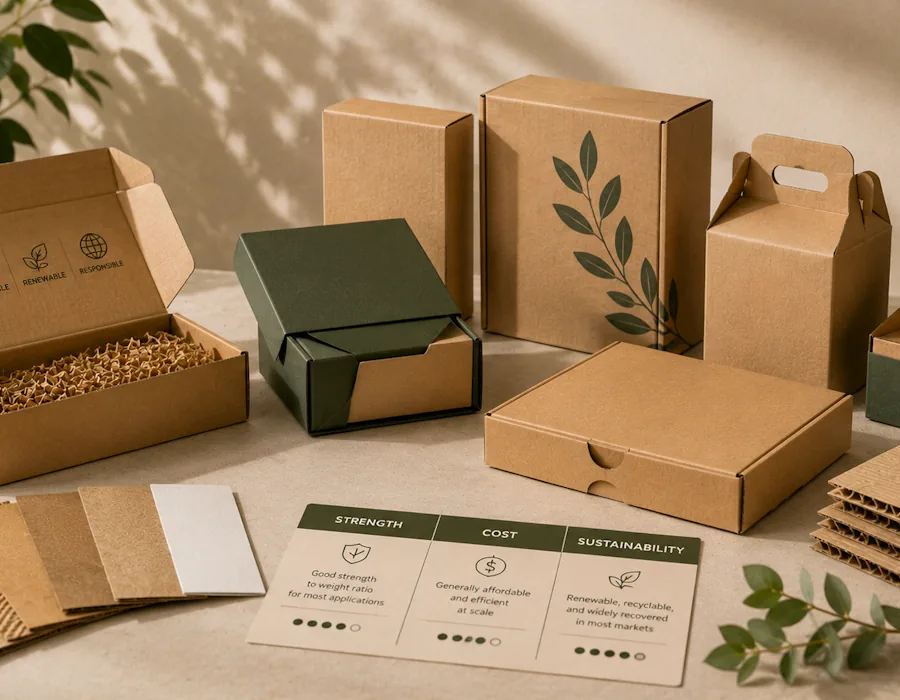
Corrugated cardboard costs more per square foot than paperboard but delivers meaningfully more stacking and impact strength, making it the right choice anywhere a package needs to survive shipping and handling on its own. Paperboard is cheaper and takes finer print detail better, making it the right choice for retail cartons that will themselves sit inside a stronger secondary or tertiary layer rather than needing to survive shipping alone. Using paperboard where corrugated strength is actually needed is one of the more common, costly packaging mistakes — it shows up later as damage claims rather than as an obvious problem at the design stage.
Custom Cardboard Packaging and Inserts
A meaningful share of demand around this term is specifically for custom and printed cardboard packaging, plus structural inserts — dividers, honeycomb panels, and shaped inserts that hold a product in place inside a box. Honeycomb cardboard, a lightweight structural material built from a honeycomb-patterned paper core, has grown as a packaging insert material specifically because it offers strong cushioning at a fraction of the weight of solid foam or dense corrugated fill, while remaining fully recyclable as a paper-based material.
Custom cardboard packaging inserts generally add cost but reduce damage and returns for fragile or oddly shaped products, which is why they’re common in categories like electronics and cosmetics despite the added unit cost — the math tends to favor them once a brand has real return-rate data showing what unprotected shipping is actually costing.
Sustainability of Cardboard Packaging
Cardboard, in both its corrugated and paperboard forms, is one of the more genuinely sustainable packaging materials by default, since it’s paper-based, widely recyclable through standard municipal systems, and often made partly or entirely from recycled content already. The main sustainability consideration isn’t the base material itself but what’s added to it — coatings, laminations, or plastic-based inks and adhesives can reduce recyclability, so a “recyclable” claim on cardboard packaging is worth checking against the specific finishing used, not assumed automatically from the base material.
Frequently Asked Questions
Is cardboard the same as corrugated?
Not exactly — “cardboard” is often used loosely to cover both corrugated board, which has a fluted structural layer, and paperboard, a flat single-layer sheet. They have meaningfully different strength and cost profiles.
Is cardboard packaging recyclable?
Generally yes, both corrugated and paperboard are widely accepted in municipal recycling, though coatings, laminations, or heavy printing can reduce recyclability depending on the specific materials used.
What are cardboard packaging inserts used for?
Inserts, including honeycomb cardboard, dividers, and shaped fill, hold a product securely inside a box to prevent movement and damage during shipping, commonly used for fragile or irregularly shaped items.
Is custom cardboard packaging expensive?
It depends on volume and complexity — custom printing on stock box sizes is relatively affordable, while fully custom die-cut structures and specialty inserts add more cost, generally justified once return or damage rates make the investment worthwhile.