

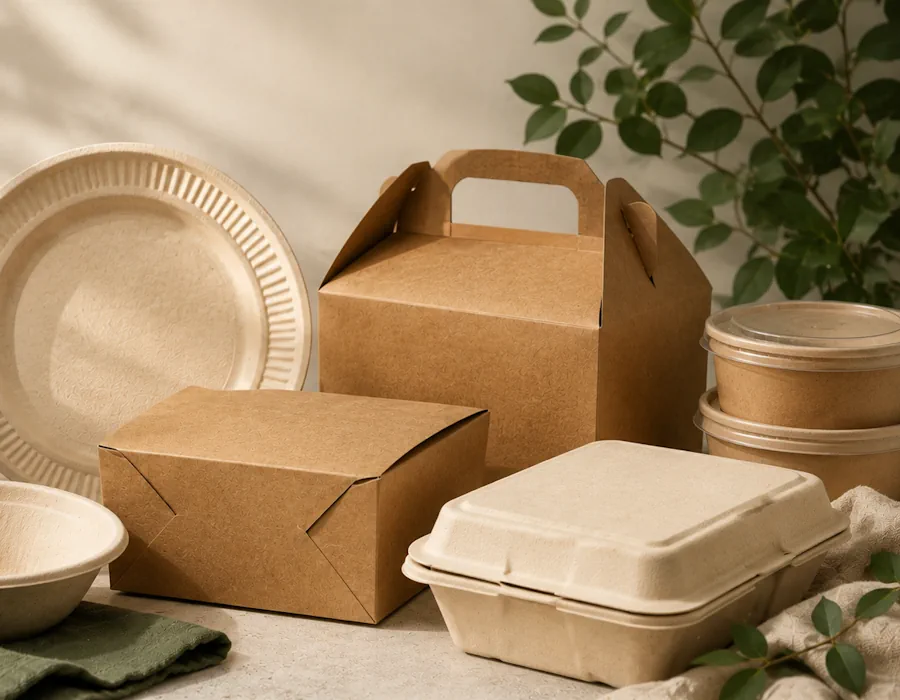
“Eco-friendly food packaging” isn’t a specific material or certification — it’s an umbrella term covering several genuinely different approaches, each with different tradeoffs. Treating it as a single checkbox is the most common mistake we see, since the right choice depends heavily on your product’s barrier needs, your customers’ access to composting or recycling infrastructure, and how much of a cost premium your business can absorb.
The Real Options, Compared
There are four broad paths brands actually take, and they’re not interchangeable. Switching to recyclable materials keeps a brand within familiar, often lower-cost materials — like mono-material plastic or paperboard — designed to work with existing municipal recycling systems, with the main risk being that “recyclable” only matters if the material is actually collected and processed as such in a given market, which varies significantly. Reducing material weight and complexity, meaning using less packaging overall or simplifying multi-layer structures into something more easily processed, is often the lowest-cost and most immediately actionable option, since it doesn’t require sourcing an entirely new material category. Moving to compostable packaging trades some barrier performance and cost for a genuinely different end-of-life outcome, but it only delivers real environmental benefit where customers have access to industrial composting, a distinction we cover in full in our compostable food packaging guide. And using biodegradable materials is the loosest and least certain of the four options, since “biodegradable” alone guarantees very little about actual real-world breakdown, a gap our biodegradable food packaging guide covers in more depth.
For most brands, the fastest realistic first step is the second option — reducing material rather than switching to it — since it doesn’t require new supplier relationships or barrier-performance testing to get started.
Choosing Based on Your Customer’s Infrastructure
This is the step most brands skip, and it’s the one that determines whether an eco-friendly packaging switch actually helps. Compostable packaging sold in a market without accessible industrial composting will very likely end up in a landfill, behaving essentially like conventional plastic despite the label. Recyclable packaging sold in a market where that specific material isn’t accepted by local recycling programs faces the same problem. Before choosing a material, it’s worth checking what’s actually collected and processed where your product is sold — not just what’s theoretically possible with the material itself.
Eco-Friendly Packaging for Small Businesses and Restaurants
Search demand specifically around small business and restaurant eco-friendly packaging is meaningful, and the practical constraints here differ from larger brands. Minimum order quantities matter more, since smaller operations can’t always absorb the higher MOQs that come with specialty sustainable materials — stock eco-friendly formats from a distributor are often more accessible than fully custom sustainable packaging at this scale. Cost premium is also a bigger factor proportionally, which is part of why material reduction and simplification tend to be the more realistic starting point for smaller operations than a full material switch. And local regulation increasingly plays a role too, since a number of cities and states now restrict specific materials, like polystyrene foam, for food service — worth checking local requirements before any packaging decision, not just as an optional upgrade.
Frequently Asked Questions
What is the most eco-friendly food packaging option?
There isn’t a single answer — it depends on your product’s barrier needs and your customers’ access to composting or recycling infrastructure. Reducing material and simplifying structures is often the most immediately actionable step regardless of product category.
Is eco-friendly food packaging more expensive?
Often yes, though the premium varies significantly by material and format. Reducing material weight tends to be the lowest-cost path, while switching to specialty compostable or biodegradable materials generally carries a real cost premium, especially at smaller order volumes.
Is compostable packaging automatically eco-friendly?
Not automatically — it depends on whether the end customer has real access to industrial composting infrastructure. Without that access, compostable packaging often doesn’t deliver its intended environmental benefit.
What eco-friendly packaging options work for small food businesses?
Stock eco-friendly formats from distributors are generally more accessible than fully custom sustainable packaging at small volumes, since minimum order quantities for specialty materials can be difficult for smaller operations to justify.

1 Comment