
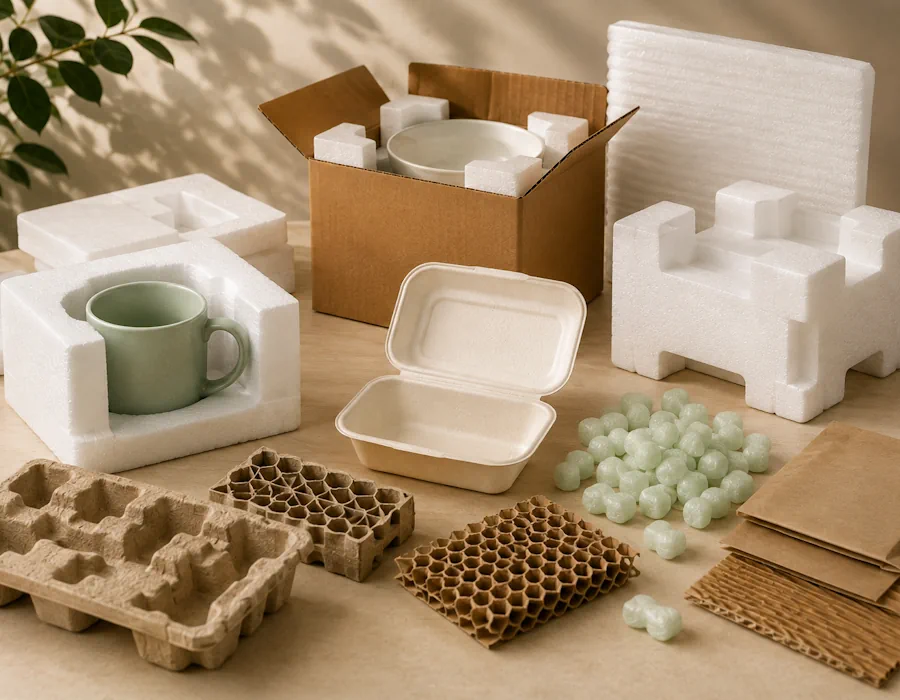
Foam packaging, most commonly expanded polystyrene (EPS, often called by the brand name Styrofoam) or molded polyethylene foam, remains widely used for one straightforward reason: it’s cheap, lightweight, and highly effective at cushioning and insulating. Among the major packaging materials, it’s also the one facing the fastest-growing regulatory pressure, which makes understanding both its real advantages and its genuine limitations more relevant than it might have been a decade ago.
Where Foam Packaging Is Still Used
Protective inserts and cushioning remain foam’s strongest use case — molded or custom-cut foam inserts hold fragile items like electronics or glassware securely in place inside a box, a job foam performs at a lower cost than most alternatives. Insulated shipping, particularly for temperature-sensitive products like perishable food or certain pharmaceuticals, still relies heavily on foam containers and panels, since foam’s insulating properties are genuinely hard to match at comparable cost and weight. Food service containers, though under increasing restriction in many markets, remain a use case in regions without specific bans in place.
Molded vs. Custom-Cut Foam Inserts
Foam inserts come in two general production methods. Molded foam is shaped in a mold specific to a product, offering a precise, form-fitting cavity — the standard for high-volume products where the upfront tooling cost is justified across a large production run. Custom-cut foam is cut from sheet stock using a die or CNC router without needing a mold, making it more cost-effective for lower volumes or products that change frequently, at some cost to the precision of fit compared to molded foam.
For a growing or smaller brand, custom-cut foam is generally the more practical starting point, with a move to molded foam making sense once volume is consistent enough to justify the mold’s upfront cost.
Environmental Concerns and Regulatory Pressure
Foam packaging, specifically expanded polystyrene, faces two compounding problems that have driven a wave of local and regional restrictions. It’s poorly suited to standard recycling infrastructure — while EPS is technically recyclable, very few municipal programs accept it, since it’s bulky, low-density, and expensive to process relative to its value as recycled material. And it breaks down into small fragments rather than fully decomposing, contributing disproportionately to litter and marine debris relative to its actual volume of use.
This combination has led a meaningful number of cities, states, and countries to restrict or ban expanded polystyrene, particularly in food service contexts, which is pushing real movement toward alternatives like molded pulp and paper-based cushioning even in applications where foam previously had a clear cost advantage — a pattern our packaging regulations guide tracks across material categories more broadly.
Alternatives to Foam Packaging
Molded pulp, made from recycled paper fiber pressed into shape, has become the most direct substitute for foam in protective packaging, particularly for electronics and consumer goods trays, though it generally offers somewhat less cushioning per unit of thickness than foam. Air pillows and paper void fill trade some of foam’s precise-fit cushioning for lower material use and easier recyclability. Corrugated inserts, using cardboard structures rather than foam, work well for products that need positioning support more than deep cushioning against impact.
Frequently Asked Questions
Can you recycle styrofoam packaging?
Technically yes, but very few municipal recycling programs accept it, since expanded polystyrene is bulky and low-value to process. Some specialty drop-off programs exist in certain areas, but curbside recycling acceptance remains limited.
Can you burn styrofoam packaging?
Burning polystyrene at home is not recommended — it releases toxic fumes when combusted outside of a controlled industrial incineration process, and doing so is illegal in many jurisdictions due to air quality regulations.
Is foam packaging being banned?
A growing number of cities, states, and countries have restricted or banned expanded polystyrene, particularly for food service packaging, though rules vary significantly by location and it’s worth checking specific local regulations before relying on foam in a new market.
What's the difference between molded and custom-cut foam inserts?
Molded foam is shaped in a product-specific mold, offering precise fit at high volumes but requiring upfront tooling cost. Custom-cut foam is cut from sheet stock without a mold, better suited to lower volumes or products that change frequently.