
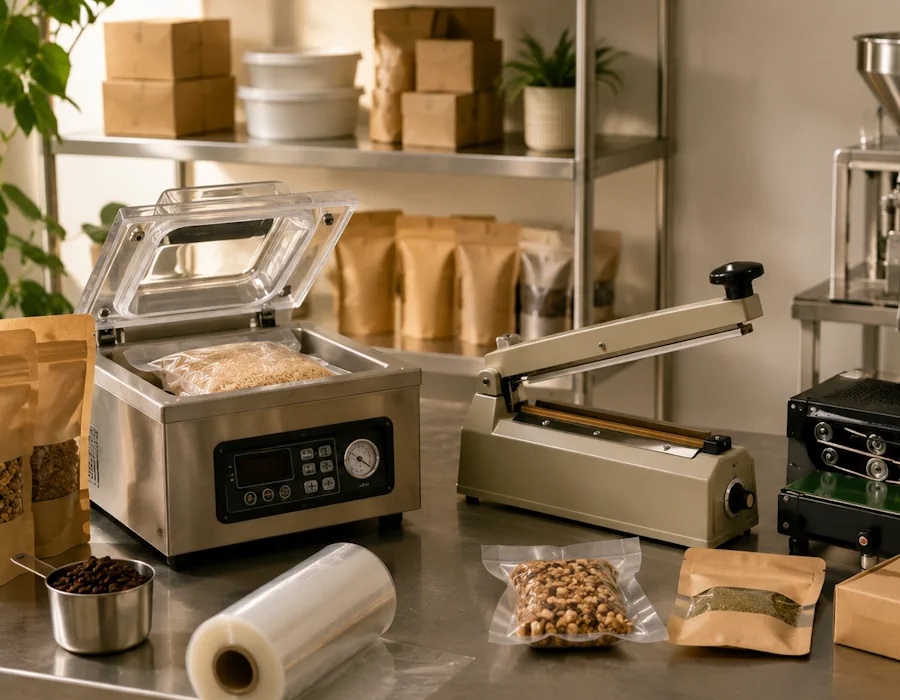
Food packaging equipment spans an enormous range, from a $200 tabletop heat sealer to a six-figure automated form-fill-seal line, and the search demand around it reflects that spread. For a small or growing food producer, the useful question isn’t “what’s the best packaging machine” — it’s what level of automation your current volume actually justifies, since buying ahead of real need ties up capital that’s usually better spent elsewhere at an early stage. This page covers the decision at a food-specific level; for the broader picture on packaging machinery across industries, see our packaging machinery guide.
Matching Equipment to Volume
Manual and semi-manual equipment — tabletop heat sealers, manual vacuum sealers, hand-crank pouch fillers — makes sense at low volume, generally under a few hundred units a day, where labor cost is lower than the capital cost of automation and flexibility to change formats matters more than speed. Semi-automated equipment, like a tabletop form-fill-seal machine or a semi-automatic tray sealer, becomes worthwhile once volume climbs into the low thousands of units per day and consistent labor cost starts to outweigh the equipment investment. Fully automated lines, integrating filling, sealing, and often labeling into one continuous process, generally only make financial sense at higher volumes, where the equipment cost is justified by labor savings and throughput over a realistic payback period, typically evaluated in years rather than months.
Buying automated equipment before volume justifies it is one of the more common early-stage mistakes — it’s usually cheaper and more flexible to run manual or semi-automated equipment slightly past the point of real discomfort than to overinvest in automation for volume you don’t have yet.
Types of Equipment by Product Category
Different food categories need genuinely different equipment, not just scaled versions of the same machine. Dry goods and snacks typically use vertical or horizontal form-fill-seal machines, which form a pouch from a roll of film, fill it, and seal it in one continuous process. Frozen food often needs equipment rated for lower operating temperatures and higher seal integrity, since frozen packaging faces more physical stress in handling and storage than room-temperature product. Liquids and sauces generally require different filling equipment entirely, built around volumetric or weight-based dosing rather than the flow-wrap mechanics used for solid products. And products needing a modified atmosphere — extending shelf life by adjusting the gas mixture inside the package — need equipment capable of that specific process, which isn’t standard on general-purpose sealing machines.
Buying New vs. Used Equipment
Used equipment is a genuine option worth considering, particularly for small producers testing a new product line before committing to new capital equipment. The tradeoffs are fairly predictable: used equipment costs meaningfully less upfront but carries more uncertainty around remaining service life and may lack current safety or efficiency features, while new equipment carries manufacturer support and warranty coverage at a materially higher price point. For equipment that’s core to daily production rather than an occasional or experimental use, the reliability of new equipment often outweighs the upfront savings of used.
Frequently Asked Questions
What packaging equipment does a small food business need to start?
Most small food producers start with manual or semi-manual equipment — a tabletop heat sealer or basic vacuum sealer — and move to semi-automated equipment once volume consistently justifies the investment.
How much does food packaging equipment cost?
It varies enormously by automation level, from a few hundred dollars for basic manual sealing equipment to well into six figures for fully automated production lines, which is why matching equipment to actual current volume matters more than buying for future volume.
Is it worth buying used food packaging equipment?
For testing a new product line or occasional use, used equipment can make sense given the lower upfront cost. For equipment central to daily production, the reliability and support that comes with new equipment often outweighs the savings.
Does frozen food need different packaging equipment than dry goods?
Yes — frozen food packaging equipment typically needs to handle lower operating temperatures and stronger seal integrity than equipment built for dry, room-temperature products.