

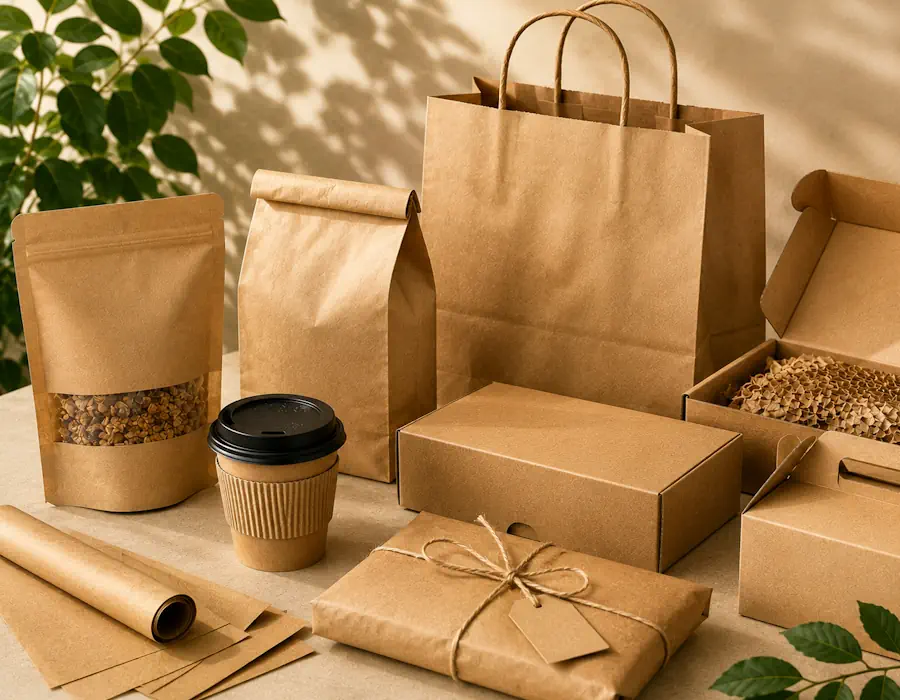
Kraft paper — recognizable by its natural, unbleached brown color and coarse texture — has grown from a purely functional, low-cost material into a deliberate branding choice for a meaningful share of brands, particularly ones positioning around sustainability or a stripped-back, natural aesthetic. It’s one of the paper-based packaging materials covered in our broader materials guide; the material itself hasn’t changed much here — what’s changed is how many brands now choose it specifically for its look, not just its price.
What Makes Kraft Paper Different
Kraft paper is made using the kraft process, a pulping method that produces notably stronger paper fiber than the standard papermaking process, which is why kraft paper can be used for load-bearing applications like shopping bags and multiwall sacks despite being relatively thin. Its natural brown color comes from leaving the pulp unbleached — bleaching kraft paper white is possible and common for some applications, but the unbleached version has become closely associated with a specific “natural” or “eco-friendly” visual signal, whether or not the packaging is actually more sustainable than a bleached or coated alternative.
That distinction matters: kraft paper’s brown color reads as sustainable to most consumers, but the actual environmental profile depends on sourcing, coatings, and end-of-life recyclability, not the color itself.
Common Uses for Kraft Paper Packaging
Bags and pouches are the most visible use — shopping bags, multiwall sacks for bulk dry goods, and increasingly stand-up pouches with a kraft paper outer layer laminated to a thin plastic or foil barrier layer inside. Wrapping and void fill use kraft paper as a lower-impact alternative to plastic air pillows or bubble wrap, offering cushioning with a fully recyclable, paper-based material. Labels and tags lean on kraft paper’s natural texture for a specific aesthetic, common in food, beverage, and personal care branding aiming for a handmade or artisanal look. Corrugated liner uses kraft paper as the linerboard in corrugated cardboard, meaning kraft paper is often part of the shipping box itself, not just a separate material choice.
The Barrier Performance Tradeoff
Kraft paper alone offers minimal barrier protection against moisture, oxygen, or grease — it’s a structural and aesthetic material more than a protective one in its pure form. This is why kraft paper used for anything beyond dry, non-perishable products typically needs a coating or an internal liner: a kraft pouch holding coffee, for instance, usually has a thin plastic or foil layer laminated to the inside to provide the barrier performance kraft paper can’t deliver on its own. That lamination, while functionally necessary, is also what complicates kraft paper packaging’s recyclability, since separating a paper-plastic laminate for recycling isn’t practical through most standard systems.
Custom Kraft Packaging
Custom printed kraft packaging is common because the material’s natural texture actually takes certain printing styles — particularly simple, high-contrast designs — very well, while more detailed or color-saturated designs generally print more vibrantly on bleached white stock. Brands choosing kraft for custom packaging are often making a deliberate tradeoff: slightly more limited print fidelity in exchange for the material’s natural aesthetic and lower-processing environmental story.
Frequently Asked Questions
Is kraft paper packaging more sustainable than other paper?
Not automatically — its unbleached, natural look is often associated with sustainability, but the actual environmental profile depends on sourcing, any coatings or laminations applied, and whether the final package is genuinely recyclable, not the brown color itself.
Can kraft paper packaging be used for food?
Yes, but usually with a coating or liner added for moisture and grease resistance, since uncoated kraft paper alone offers minimal barrier protection.
Why do brands choose kraft paper packaging?
Often for its natural, unbleached aesthetic, which signals simplicity and sustainability to many consumers, in addition to its genuine cost and recyclability advantages when used without heavy lamination.
Is kraft paper recyclable?
Uncoated kraft paper is widely recyclable through standard paper recycling. Kraft paper laminated with plastic or foil for barrier performance is considerably harder to recycle, since separating the layers isn’t practical at municipal recycling scale.


1 Comment