
Every packaging decision eventually comes down to material, and material is where cost, durability, sustainability, and manufacturability all collide. There’s no universal “best” material — the right one depends on which of those four factors matters most for a specific product — but understanding the real tradeoffs between the major categories makes that decision much faster than starting from scratch each time.
Paper and Cardboard
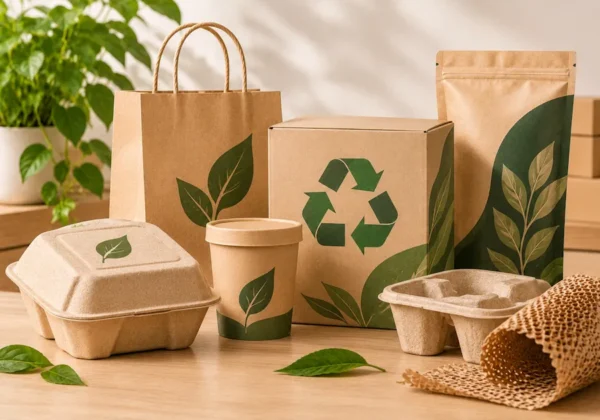
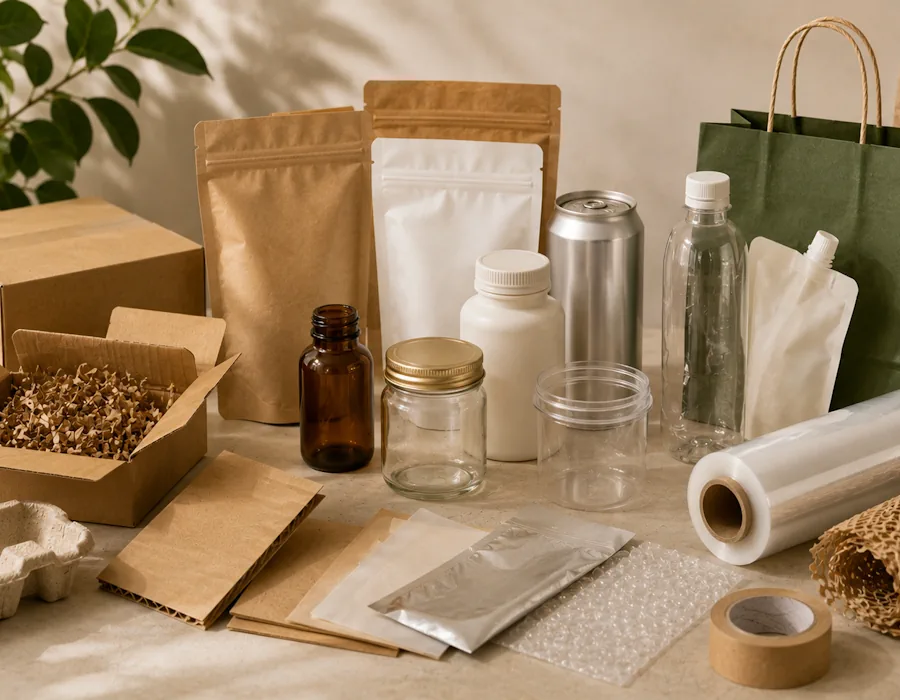
Corrugated cardboard, built from fluted layers between flat sheets, is the workhorse of secondary and tertiary packaging — strong for its weight, inexpensive, and widely recyclable through standard municipal systems. It comes in different flute sizes and wall counts (single, double, triple) depending on how much stacking strength a shipment needs, a decision that has real cost implications since thicker corrugated costs more per square foot. Paperboard is thinner and smoother, favored for retail cartons where print quality matters more than raw strength. Kraft paper, recognizable by its natural brown color and texture, is used for bags and increasingly for pouches as brands look for a lower-plastic alternative, though it generally can’t match flexible film’s barrier performance without an added coating or liner.
We go deeper on the specific grades, cost ranges, and structural options for corrugated packaging on its own page, since it’s the single most widely used packaging material by volume.
Rigid and Flexible Plastic
Plastic packaging splits into two categories that behave differently enough to warrant separate treatment. Rigid plastic — HDPE, PET, PP among the most common resins — holds its shape independently and is moldable into complex forms, which is why it dominates bottles, tubs, jars, and clamshells. Flexible plastic — films, pouches, laminates — conforms to the product it holds and uses meaningfully less material per unit of protection than rigid plastic, which has driven its fast growth in categories trying to reduce shipping weight and cost.
The sustainability picture differs sharply between the two. Rigid plastic recyclability varies by resin — PET and HDPE are among the more commonly accepted materials in municipal recycling, while other resins are accepted far less consistently depending on region. Flexible film, particularly multi-layer film combining different plastic types to achieve specific barrier properties, is considerably harder to recycle through standard systems, since separating those layers isn’t practical at scale — a limitation that shows up repeatedly across food categories like coffee and snacks. We cover flexible packaging specifically, including where mono-material alternatives are closing this gap, in more depth separately.
Glass
Glass is chemically inert, meaning it won’t react with or absorb flavors, odors, or active ingredients from what it holds — the reason it remains standard for products where purity is critical, including spirits, certain pharmaceuticals, and premium food and beverage. It’s infinitely recyclable without any loss in quality, which makes it one of the strongest options on that specific dimension. The tradeoff is weight: glass is meaningfully heavier than plastic alternatives, which raises both shipping cost and emissions, and it carries real breakage risk that plastic and metal don’t.
Metal
Aluminum and steel, primarily as cans, tubes, and foil, offer excellent barrier protection against light and oxygen — better, in most cases, than plastic or paper alone. Aluminum in particular holds real recycling value as scrap, which supports genuinely high real-world recycling rates compared to many other materials. The primary tradeoff is production energy: metal packaging is generally more energy-intensive to manufacture than plastic or paper, even though its end-of-life recycling profile is strong.
Molded Pulp and Fiber
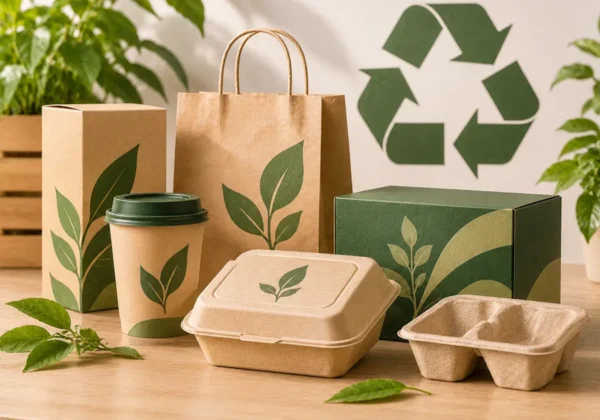
Made by pressing recycled paper or plant fiber into shape, molded pulp is most visible in egg cartons, but its use is expanding fast into protective trays that used to be foam — inside electronics packaging, cosmetics boxes, and increasingly food packaging for delicate items. It’s biodegradable and typically made from recycled content, but it’s less durable under moisture than plastic foam without an added coating, and production costs favor larger runs, making it less accessible at very small order volumes.
Foam (EPS/Polystyrene)
Foam remains common for protective packaging and some food service applications thanks to its low cost and effective insulation and cushioning, but it’s under real and growing regulatory pressure — a number of markets have banned or restricted expanded polystyrene specifically, particularly in food service contexts. Poor recyclability through standard municipal systems is the core issue, and it’s a major driver behind molded pulp and other alternatives gaining ground in exactly the applications foam used to dominate.
Biodegradable and Compostable Materials
This is the fastest-growing category by search demand and product development activity. Plant-based bioplastics like PLA, derived largely from corn starch, are the most common, alongside newer materials like PHA and mushroom-based (mycelium) packaging. The critical distinction within this category — and one worth understanding before choosing any of these materials — is that “compostable” almost always means industrially compostable, requiring a facility most consumers don’t have direct access to, not something that will break down in a home compost bin or a landfill. We cover this distinction, along with the broader biodegradable-versus-compostable question, in our sustainable packaging guide and in our dedicated compostable food packaging and biodegradable food packaging guides.
Comparing Materials at a Glance
| Material | Barrier performance | Weight | Recyclability | Relative cost |
|---|---|---|---|---|
| Corrugated cardboard | Low-moderate | Light | High | Low |
| Rigid plastic | Moderate-high | Light-moderate | Varies by resin | Low-moderate |
| Flexible film | High | Very light | Low (multi-layer) to moderate (mono-material) | Low |
| Glass | High | Heavy | Very high | Moderate-high |
| Metal | Very high | Moderate | High | Moderate |
| Molded pulp | Low-moderate | Light | High | Low-moderate |
| Foam (EPS) | Moderate (insulation) | Very light | Low | Low |
| Biodegradable/compostable | Varies, often lower than conventional | Light | High, but requires specific infrastructure | Moderate-high |
How to Actually Choose
Start with the job the packaging has to do, not the material itself. If barrier protection against oxygen or moisture is the dominant risk to your product, flexible film, glass, or metal will outperform paper-based options. If weight and shipping cost are the binding constraint, flexible plastic or molded pulp will beat glass or heavy rigid plastic. If end-of-life impact and recyclability matter most to your brand and your customers have access to the right infrastructure, paper-based materials or genuinely mono-material plastics will outperform multi-layer or composite structures. And if cost is the dominant constraint, corrugated cardboard and flexible film remain the two lowest-cost options for the protection they deliver, which is a large part of why they’re the two most widely used packaging materials globally.
Frequently Asked Questions
What is the most common packaging material?
By volume, corrugated cardboard and flexible plastic film are the two most widely used packaging materials globally, largely due to their strong protection-to-cost ratio.
What is the most sustainable packaging material?
There’s no single answer — it depends on the product’s barrier needs and the waste infrastructure available where it’s sold. A material that’s technically more recyclable or compostable isn’t automatically the better environmental choice if it fails at protecting the product or if local infrastructure can’t actually process it.
Which packaging material is cheapest?
Corrugated cardboard and flexible plastic film are generally the least expensive options per unit of protection, which is why they dominate by volume across most industries.
Is glass better than plastic for packaging?
Neither is universally better — glass is inert and infinitely recyclable but heavy and fragile, while plastic is lightweight and durable but has a more complicated recycling picture depending on resin type. The right choice depends on the specific product and its shipping and handling profile.