
Pharmaceutical packaging carries a heavier regulatory and technical burden than almost any other packaging category, for a straightforward reason: a packaging failure here isn’t a cosmetic problem or even just a spoilage problem, it’s a direct patient safety issue. Container-closure integrity, child-resistant design, and supply chain traceability aren’t optional design choices in this category the way they might be elsewhere — they’re legal requirements enforced by regulatory bodies with real authority to halt distribution.
This guide covers what makes pharmaceutical packaging distinct, the main format and material choices, and where to go deeper on specific requirements.
Why Pharmaceutical Packaging Is Different
Three things separate pharmaceutical packaging from consumer packaging generally. Container-closure integrity, meaning the seal between a package and its closure has to be validated to prevent contamination or degradation over the product’s full shelf life, is tested and documented in a way that has no real equivalent in most consumer categories. Regulatory validation applies to more than just the finished package — the equipment and process used to produce it are also subject to validation, meaning a change to either can trigger a need for regulatory revalidation, not just a design update. And patient-facing functional requirements, like child-resistant closures and tamper-evidence, are legally mandated for many drug categories rather than being a brand’s discretionary choice.
Primary Packaging in Pharmaceuticals
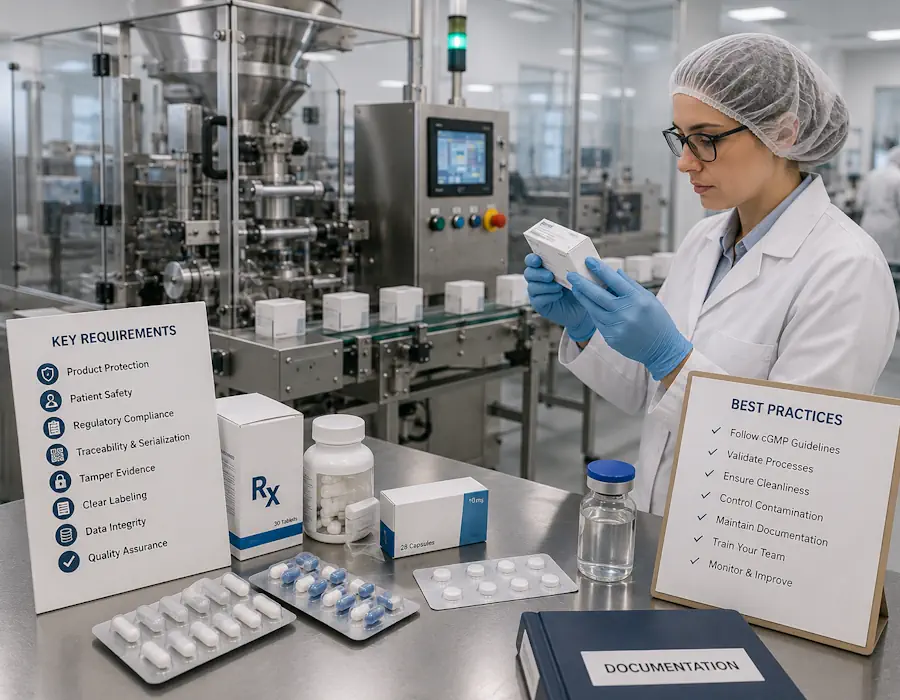
Primary packaging — the layer in direct contact with the drug product — carries the most stringent requirements of any layer, since it directly affects the product’s stability and safety. Blister packs remain the dominant format for solid oral doses like tablets and capsules, valued for their individual-dose isolation and tamper-evidence. Vials and ampoules are standard for injectable and liquid formulations, chosen partly for the inert, stable barrier that glass or specific plastic resins provide. Bottles with child-resistant closures are common for multi-dose oral medications, particularly over-the-counter products where child-resistant packaging is often a specific legal requirement. Container-closure systems more broadly — meaning any primary package plus its cap or seal — require compatibility testing to confirm the packaging won’t interact with or degrade the specific drug formulation it holds.
Pharmaceutical Packaging Design
Design in this category has to balance patient usability against regulatory compliance in a way that’s more constrained than most consumer packaging. Readability and accessibility, particularly for elderly or visually impaired patients, are a real design consideration, not just an aesthetic one, given how directly dosing errors can affect patient safety. Child-resistant design has to pass specific, standardized testing protocols rather than simply being harder to open by feel. And any packaging design change for an already-approved drug product can require regulatory filing and review, which is why pharmaceutical packaging redesigns happen far less frequently, and far more deliberately, than redesigns in most other categories.
Track and Trace and Serialization
A growing area of pharmaceutical packaging is serialization — printing a unique identifying code on individual units or packages to enable supply chain tracking from manufacturer to pharmacy. This is driven by anti-counterfeiting regulation in a growing number of markets, and it affects both the packaging design (space for the code) and the equipment used to apply and verify it during production.
Pharmaceutical Packaging Equipment
Manufacturing pharmaceutical packaging typically requires more specialized equipment than most consumer categories, largely due to the validation requirements involved. Blister packaging machines, which we cover in detail separately, are the most common primary packaging equipment for solid oral doses. Filling and sealing equipment for vials and ampoules requires sterile or aseptic processing capability for injectable products specifically. And serialization and vision inspection systems, verifying printed codes and detecting packaging defects, are increasingly standard on pharmaceutical packaging lines given the regulatory push toward full traceability.
Sourcing Pharmaceutical Packaging
Working with pharmaceutical packaging suppliers and companies involves a different evaluation than sourcing consumer packaging, since regulatory compliance history and validation documentation matter as much as cost and lead time. A supplier’s track record with the relevant regulatory bodies for your specific markets, and their experience with your specific drug category (solid oral dose vs. injectable vs. topical, for instance), are worth confirming directly rather than assuming general pharmaceutical packaging experience transfers evenly across these categories.
Sustainability in Pharmaceutical Packaging
Sustainability efforts in pharmaceutical packaging move more slowly than in most consumer categories, largely because any material change to an approved drug’s packaging can trigger regulatory review — the same constraint that slows design changes generally. That said, real movement exists in reducing secondary packaging material, exploring recyclable blister alternatives, and improving primary packaging efficiency, particularly for newer products where sustainability can be built in from the initial approval process rather than retrofitted later.
Frequently Asked Questions
What makes pharmaceutical packaging different from other packaging?
Pharmaceutical packaging carries significantly heavier regulatory requirements, since packaging failures directly affect patient safety — container-closure integrity, validated manufacturing processes, and legally mandated features like child-resistant closures are standard requirements here in a way they aren’t for most consumer packaging.
What is the most common type of pharmaceutical primary packaging?
Blister packs are the dominant format for solid oral doses like tablets and capsules, while vials and ampoules are standard for injectable and liquid formulations.
Why is pharmaceutical packaging validation important?
Validation confirms that a packaging process and equipment consistently produce packaging that meets safety and quality standards. Because it’s tied to regulatory approval, changes to validated packaging or equipment can require regulatory review before they can be implemented.
Is pharmaceutical packaging becoming more sustainable?
Slowly, and more cautiously than most consumer categories, since packaging changes for already-approved drugs can trigger regulatory review. Sustainability improvements are more achievable for newly developed products where they can be built into the initial approval process.