
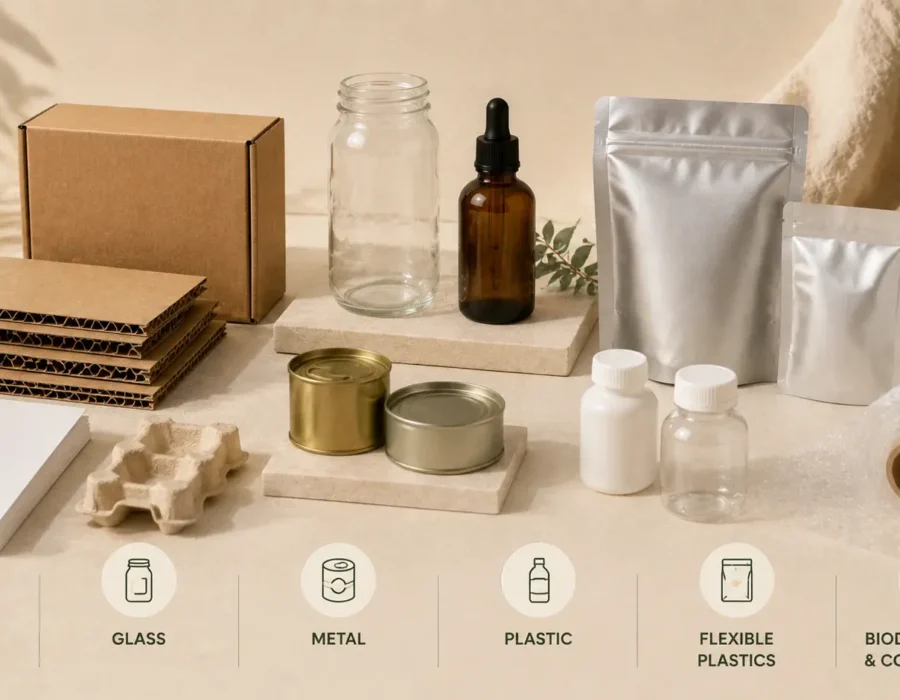
Packaging materials fall into a handful of broad categories, and almost everything you’ll encounter — across primary, secondary, and tertiary layers — is a variation on one of them. This page is a fast overview of each category: what it is, where it’s typically used, and its real tradeoffs. Our complete packaging materials guide goes much deeper on each one.
Paper-Based Packaging
The broadest category, covering corrugated cardboard, paperboard, and kraft paper. Corrugated cardboard uses fluted layers between flat sheets, giving it strength relative to its weight — the standard choice for shipping boxes and secondary or tertiary packaging. Paperboard is thinner and smoother, more printable, and common for retail cartons like cereal boxes and cosmetic cartons. Kraft paper is used for bags and wraps, and increasingly for pouches as a lower-impact alternative to plastic film.
Paper-based packaging is used in secondary and tertiary packaging almost universally, and in primary packaging for dry goods. It’s widely recyclable and generally lower-cost, but has weaker moisture and barrier performance than plastic or glass without added coatings.
Plastic Packaging (Rigid and Flexible)
Plastic splits into two functionally different categories worth treating separately. Rigid plastic — HDPE, PET, PP — holds its shape without external support: bottles, tubs, jars, clamshells. It’s moldable into complex shapes, which makes it common wherever a specific silhouette matters for branding or function. Flexible plastic — films, pouches, laminates — is lightweight and conforms to the product, used for stand-up pouches, shrink wrap, and bags. It uses far less material per unit than rigid plastic for a similar level of protection, which is why it’s grown fast in categories trying to cut shipping weight.
Plastic packaging shows up in primary packaging across almost every industry, plus shrink film at the tertiary level. It offers excellent barrier and durability properties, but rigid plastic recycling rates vary enormously by resin type and region, and multi-layer flexible film, which mixes plastic types to get barrier performance, is often not recyclable through standard municipal systems at all — our sustainability guide covers how this actually plays out.
Glass
Glass is chemically inert — it doesn’t react with or absorb flavors, odors, or active ingredients from what it holds, which is why it remains the standard for products where purity matters most, like spirits, certain pharmaceuticals, and premium food. It’s used almost exclusively in primary packaging, and while it’s infinitely recyclable without quality loss, it’s heavy, which raises both shipping cost and breakage risk relative to plastic.
Metal
Aluminum and steel, mostly in the form of cans, tubes, and foil, are used in primary packaging for beverages, some foods, and aerosols, and as foil within flexible packaging. Metal gives excellent barrier protection against light and oxygen and is highly recyclable — aluminum in particular retains value well as scrap — but it’s more energy-intensive to produce than most alternatives.
Molded Pulp and Fiber
Made from recycled paper or plant fiber and pressed into shape, think egg cartons, or the trays increasingly replacing foam inside electronics and cosmetics boxes. It’s used mainly for protective inserts and trays, and while it’s biodegradable and made largely from recycled material, it’s less durable under moisture than plastic foam, and molding costs favor larger production runs.
Foam (EPS/Polystyrene)
Still common for protective packaging and some food service, though under increasing regulatory pressure — a number of markets have banned or restricted expanded polystyrene specifically. It’s cheap and effective for insulation and cushioning, but has poor recyclability in most municipal systems and a growing list of local bans.
Biodegradable and Compostable Materials
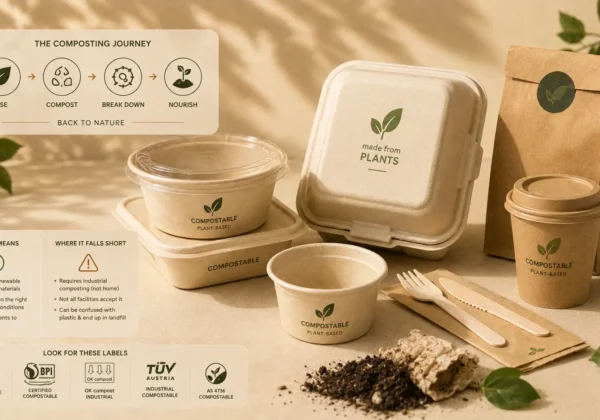
A newer, fast-growing category — plant-based plastics (PLA), mushroom-based packaging, and compostable films designed to break down under specific conditions. It’s showing up increasingly in primary packaging for food, some cosmetics, and shipping mailers. These materials genuinely lower environmental impact under the right conditions, but “compostable” almost always means industrially compostable — most of these materials won’t break down in a home compost bin or a landfill, which is one of the more common points of confusion, and greenwashing risk, in this category.
How to Choose Between Them
There’s no universal “best” material — the right choice depends on which of packaging’s core jobs matters most for a given product: barrier protection, weight, cost, shelf appeal, or end-of-life impact. A frozen food brand will weight barrier performance heavily; a DTC skincare brand shipping direct to consumers will weight weight and unboxing experience; a bulk commodity producer will weight cost above almost everything else. For a full side-by-side comparison with cost and sustainability data for each material, see Packaging Materials 101.
Frequently Asked Questions
What are the 4 main types of packaging materials?
Most classifications group materials into paper/cardboard, plastic (rigid and flexible), glass, and metal, with biodegradable materials increasingly treated as a fifth, fast-growing category.
What packaging material is most sustainable?
There’s no single answer — it depends on the product, the barrier properties needed, and the waste infrastructure available where it’s sold. Paper is often assumed to be “more sustainable” than plastic by default, but a plastic package that prevents food waste can have a lower overall environmental footprint than a paper alternative that doesn’t protect the product as well.
What is the cheapest packaging material?
By raw material cost, flexible plastic film and corrugated cardboard are generally the least expensive options per unit of protection, which is part of why they’re the two most widely used packaging materials globally.
Is glass or plastic better for packaging?
Neither is universally “better” — glass is inert and infinitely recyclable but heavy and fragile; plastic is lightweight and durable but has a more complicated recycling picture. The right choice depends on the product and its shipping profile.