

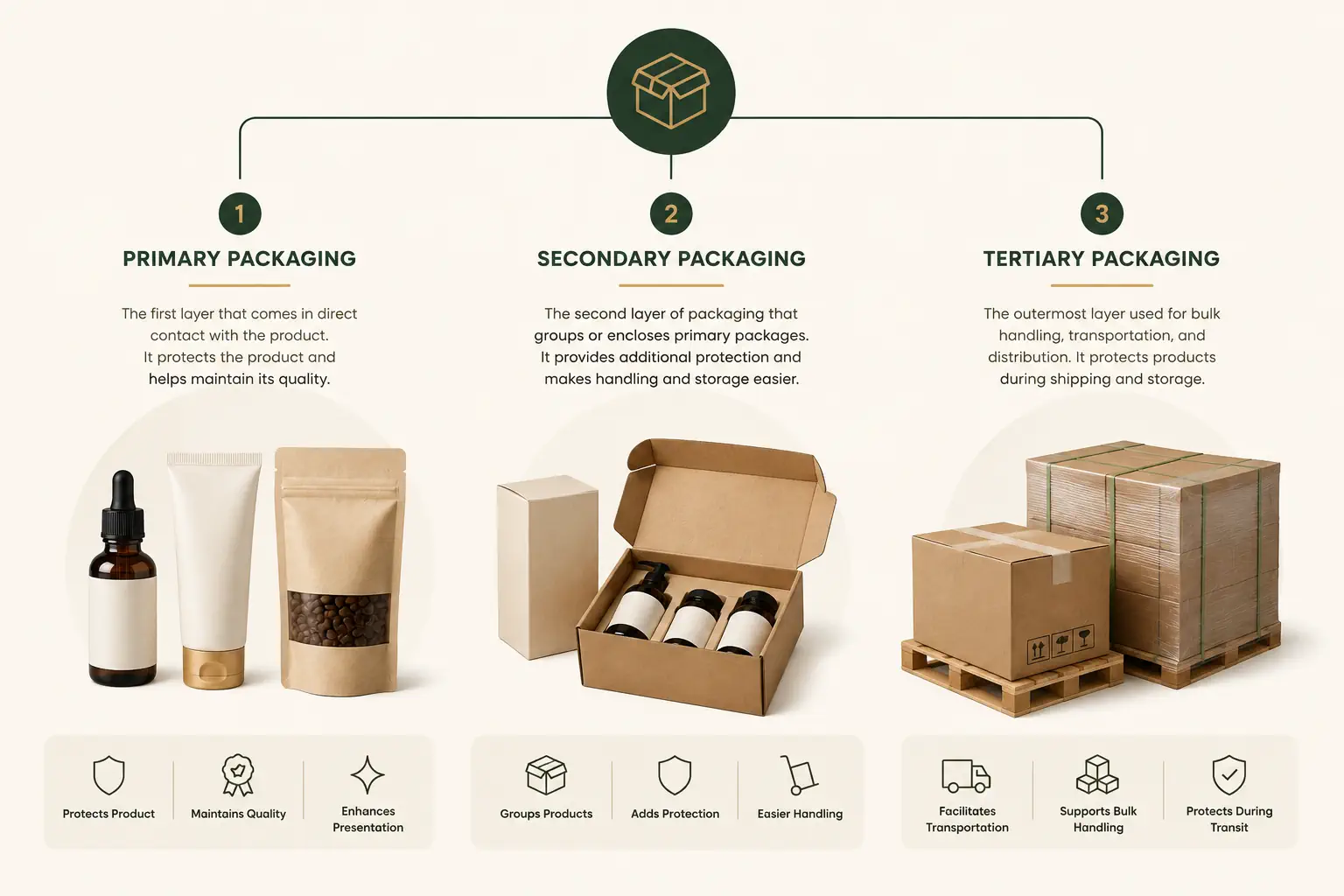
Every packaging system is built from up to three layers — primary, secondary, and tertiary — and the difference between them comes down to one question: does this layer touch the product, and who is it built for? Primary packaging touches the product directly and is built for the product’s protection. Secondary packaging groups primary packages and is built mostly for the customer and retailer. Tertiary packaging groups secondary packages in bulk and is built purely for warehousing and shipping.
We’ve covered each layer in depth separately in our guides to primary, secondary, and tertiary packaging — this page puts them side by side and walks through how to decide which layer actually needs your attention for a given problem.
Side-by-Side Comparison
| Primary | Secondary | Tertiary | |
|---|---|---|---|
| Touches product? | Yes | No | No |
| Seen by end customer? | Yes | Yes | Almost never |
| Typical unit | Single item | Group of items | Group of cases/pallets |
| Main job | Contain, protect, preserve | Group, brand, present | Bulk protect, transport |
| Example | Bottle, blister pack | Carton, case | Shrink-wrapped pallet |
| Regulatory load | Highest | Moderate (labeling) | Lowest (mostly handling/hazard labels) |
| Typical material | Glass, rigid plastic, film | Corrugated, paperboard | Stretch film, heavy corrugated, pallets |
| Who usually owns the decision | Product/regulatory team | Brand/marketing team | Operations/logistics team |
That last row is worth sitting with — in a lot of companies, these three layers are literally decided by different people, working from different priorities, which is exactly how you end up with a beautifully branded secondary carton that doesn’t fit efficiently on a pallet, or a primary bottle whose shape wastes space in the case built around it.
How to Decide Which Layer to Focus On
If you’re trying to solve a packaging problem — cost, damage, sustainability, or design — the fastest way to figure out where to focus is to identify which job is actually failing. If product is arriving damaged, leaking, or degraded before purchase, that’s a primary packaging problem; look at barrier properties, closure integrity, and material compatibility first. If customers can’t tell what the product is, or it’s not standing out at retail, that’s a secondary packaging problem, a design and information-hierarchy issue rather than a material one, which our packaging design guide covers directly. If products are arriving damaged in transit, or shipping costs are climbing, that’s very likely a tertiary packaging problem, and specifically a fit and stacking problem — a surprising amount of “damage in shipping” is actually a secondary-tertiary mismatch. And if overall packaging spend feels too high but you’re not sure why, that usually isn’t one layer, it’s a systems problem across all three, something our guide to packaging costs and sourcing breaks down.
A Common Mistake: Optimizing One Layer in Isolation
The most frequent error we see brands make is redesigning one layer — usually secondary packaging, since it’s the most visible — without checking how that change ripples through the other two. A slightly taller secondary carton can look identical on a shelf but throw off pallet stacking entirely, quietly adding a full extra layer of shipping cost that never shows up in the design review. Any packaging change that touches dimensions is worth checking against all three layers, not just the one being redesigned.
Frequently Asked Questions
What is the easiest way to remember the difference between the three types?
Primary touches the product. Secondary groups primary packages for retail. Tertiary groups secondary packages for shipping. If you can answer “who is this layer built for” — the product, the customer, or the warehouse — you’ve identified the layer.
Do all products need all three layers?
No. A single unwrapped item sold loose might only have primary packaging. A product shipped direct-to-consumer in small volumes might combine secondary and tertiary into one shipping box. Larger, retail-distributed products are the ones most likely to use all three distinctly.
Is this classification used the same way in pharma as in other industries?
Mostly yes, though pharmaceutical primary and secondary packaging carry additional regulatory requirements — container-closure validation, serialization, and tamper-evidence — that don’t apply to most consumer goods.
Which layer costs the most?
It depends on the product, but as a general pattern, primary packaging tends to carry the highest per-unit cost, since material compatibility requirements drive this, while tertiary packaging costs scale with shipment volume rather than product complexity.