
Food packaging labels carry more mandatory information than almost any other packaging category, and getting the required elements wrong isn’t just a design fix — a mislabeled allergen or missing nutrition information is one of the more common causes of food recalls. Understanding what’s actually required, versus what’s a useful addition, is worth sorting out before a label design gets finalized rather than after.
What’s Legally Required
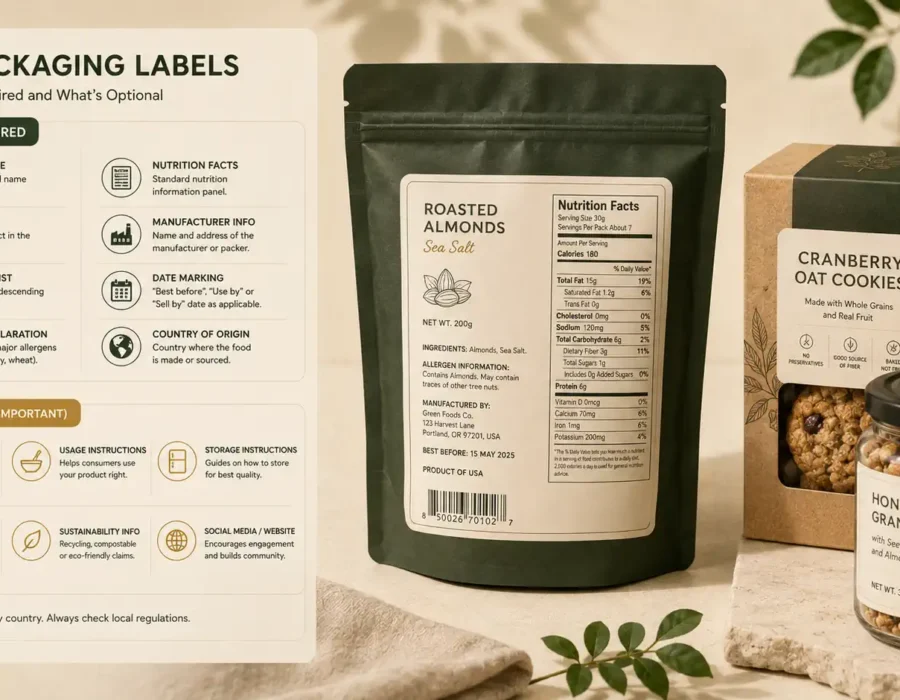
While specific requirements vary by country, most markets require a consistent core set of information on food packaging. Ingredient lists, typically ordered by weight from most to least, are close to universal. Allergen declarations, calling out major allergens like nuts, dairy, soy, and gluten, are required in most markets and are one of the most heavily enforced areas of food labeling, since allergen mislabeling poses a direct health risk. Nutrition facts, covering serving size, calories, and key nutrients in a standardized format, are required for most packaged foods, though the exact format differs meaningfully between regions. Net weight or volume, stating the actual quantity of product in the package, is a near-universal requirement. And a name and address for the manufacturer, packer, or distributor is typically required so a product can be traced back to its source if needed.
Because these requirements differ by market — what’s mandatory in one country may be optional or formatted differently in another — any brand selling across multiple regions needs country-specific label review rather than assuming one label design works everywhere. Our broader packaging regulations guide covers how these requirements shift by market in more depth.
What’s Optional But Common
Beyond the legally required elements, a number of label features are common but not mandatory. Best-by or use-by dates are required in some markets and voluntary in others, though most brands include them regardless given consumer expectations. Sustainability and sourcing claims, like “recyclable” or “sourced from,” carry their own regulatory scrutiny in many markets even though the underlying label isn’t mandatory — a claim that isn’t substantiated can create legal exposure independent of the core label requirements. QR codes linking to extended product information are increasingly common as a way to include more detail than physical label space allows. And freshness or quality indicators, like color-change strips showing spoilage, remain a smaller but growing category, mostly in more premium or specialty food segments.
Designing Around Required Information
The practical design challenge with food packaging labels is fitting mandatory information into a hierarchy that doesn’t overwhelm the brand elements the package also needs to carry. A few patterns tend to work: grouping required regulatory information into a consistent, clearly delineated area of the package rather than scattering it, using the primary display panel almost entirely for branding and product identification, and treating the information panel as a design problem in its own right rather than an afterthought bolted on once the “real” design is finished. This is closely tied to broader packaging design principles around information hierarchy and shelf communication.
Frequently Asked Questions
What information is legally required on food packaging?
At minimum, most markets require an ingredient list, allergen declarations, nutrition facts, net weight, and manufacturer or distributor information, though exact requirements vary by country.
Do best-by dates have to be on food packaging?
It depends on the market — some countries require date labeling on most packaged foods, while others leave it voluntary, though most brands include it regardless of legal requirement due to consumer expectations.
Can I make sustainability claims on food packaging without certification?
This varies by market and by the specific claim, but unsubstantiated environmental claims carry real regulatory and legal risk in a growing number of jurisdictions, independent of whether a formal label requirement exists for that claim.
Do food packaging label requirements differ between countries?
Yes, significantly — formatting, required nutrients, allergen lists, and even what counts as a major allergen all vary by market, which is why multi-market brands typically need region-specific label reviews rather than a single global design.