
Custom food packaging means packaging built to your exact specifications — dimensions, branding, barrier properties — rather than pulled from a supplier’s existing catalog of stock formats. It’s where most food brands eventually land once volume justifies the higher upfront cost and minimum order quantities, but the process and pricing structure look different enough from buying off the shelf that it’s worth understanding before requesting quotes.
What “Custom” Actually Covers
Custom food packaging spans a range, from relatively small changes to a fully bespoke structure. Custom labels or printing on an otherwise stock bag or box is the lightest form of customization, often achievable at lower minimums than a fully custom structure. Custom dimensions on a standard format, like a stock pouch style resized to fit a specific product, is a step up in cost and complexity. Fully custom structure, meaning a unique shape, closure, or barrier construction built from scratch, is the most expensive and slowest path, typically reserved for brands with proven volume and a specific functional need stock formats can’t meet.
Most small and growing brands start at the first level, custom printing on stock structures, since it delivers most of the branding benefit without the cost and lead time of a fully custom build.
The Custom Packaging Process
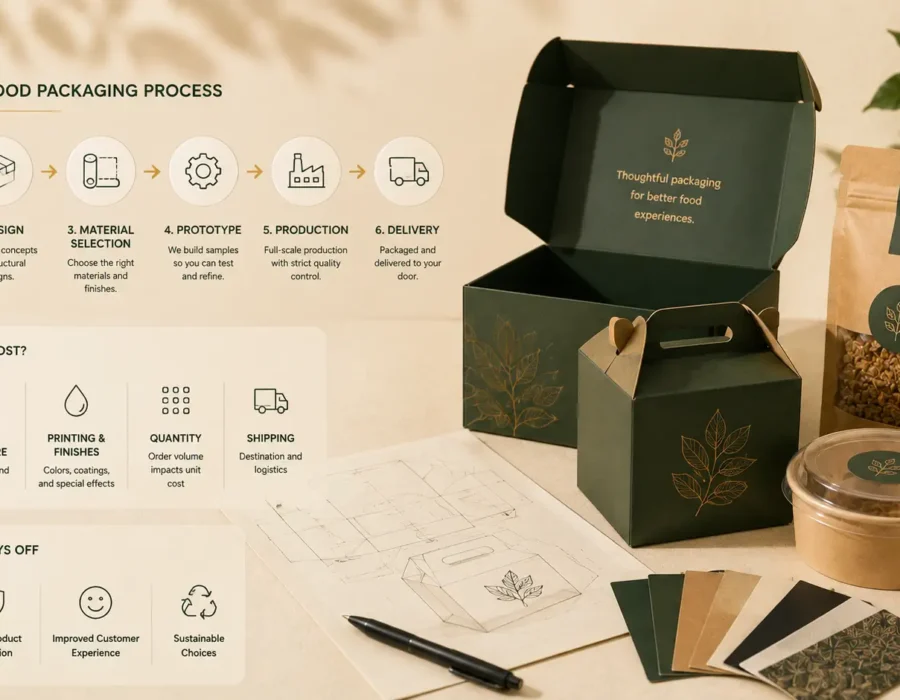
The process generally follows a consistent sequence regardless of supplier. It starts with a design brief, specifying dimensions, materials, barrier requirements, and branding. The supplier then produces a design proof, and often a physical sample or prototype, which is where problems are far cheaper to catch than after a full production run. Once the design is approved, plates or dies are created for printing and cutting, a one-time cost that’s often the least understood part of custom packaging pricing. Production then runs at the agreed minimum order quantity, followed by quality checks and shipping.
Lead time from initial brief to delivered product commonly runs six to twelve weeks for a first custom order, meaningfully longer than the days-to-few-weeks timeline typical of stock packaging.
What Custom Food Packaging Costs
Pricing breaks down into a few distinct components that are easy to miss when comparing quotes. There’s usually a one-time setup cost covering plates, dies, or tooling, which doesn’t scale with order volume and is the reason small custom orders often look disproportionately expensive per unit. Per-unit material and printing cost then scales down as volume increases, which is why the crossover point where custom becomes cheaper than stock packaging tends to arrive sooner than most first-time buyers expect once tooling cost is spread across a large enough run. And reorders are typically cheaper than the first order, since setup costs are a one-time expense rather than a recurring one.
As a general pattern, per-unit cost drops meaningfully between an initial run and a repeat order at the same volume, which is worth factoring in if a first quote seems high relative to a stock alternative.
Minimum Order Quantities
MOQs vary significantly by format and printing method. Digital printing on stock structures often allows for lower minimums, sometimes in the low hundreds of units, at a higher per-unit cost. Traditional flexographic or rotogravure printing, more common for high-volume custom pouches and film, typically requires minimums in the thousands to tens of thousands of units to be cost-effective, since setup costs for these methods are higher and only make sense spread across a larger run.
If your current volume doesn’t clear a supplier’s MOQ comfortably, it’s usually a signal to look at digital printing options or stay with stock packaging a bit longer rather than committing to inventory you won’t move quickly.
Frequently Asked Questions
How much does custom food packaging cost per unit?
It varies widely by material, format, and volume, but the general pattern is that custom packaging carries a real one-time setup cost on top of per-unit pricing, meaning cost per unit drops as order volume increases and drops further on reorders once that setup cost is already paid.
What's the minimum order for custom food packaging?
This depends heavily on printing method — digital printing can start in the low hundreds of units, while traditional printing methods common for high-volume pouches often require minimums in the thousands.
How long does custom food packaging take to produce?
A first custom order typically takes six to twelve weeks from design brief to delivery, factoring in proofing, tooling, and production. Reorders are usually faster since tooling already exists.
Is custom food packaging worth it for a small business?
It depends on volume and stage — many small brands start with custom printing on stock formats to get branding benefits at lower minimums, then move to fully custom structures once consistent volume justifies the higher cost and MOQ.