
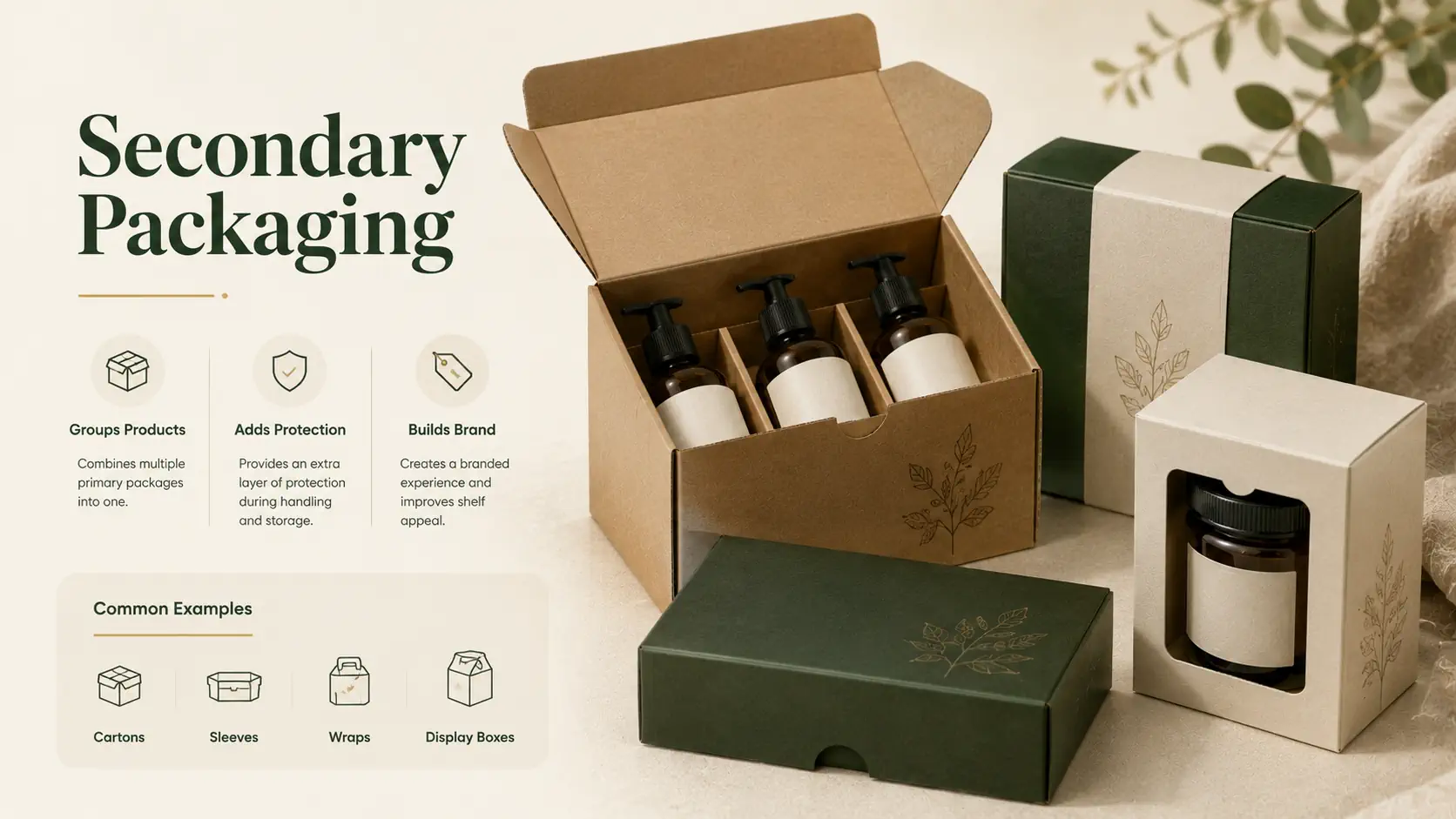
Secondary packaging is the layer that groups primary packages together — the printed carton around a tube of toothpaste, the cardboard case holding twelve bottles, the six-pack ring around a set of cans. Unlike primary packaging, it doesn’t touch the product directly. Its job is different: grouping, branding, and getting products through retail and transit in one recognizable unit.
What Counts as Secondary Packaging
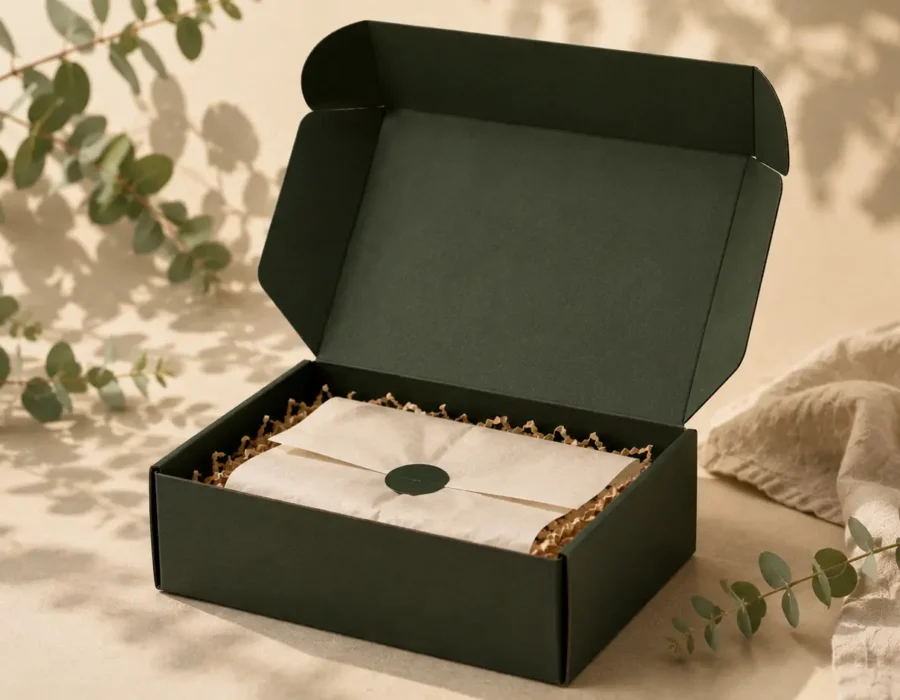
The test is the same one used for primary packaging, just inverted: if it doesn’t touch the product, and it’s not built purely for bulk shipping, it’s probably secondary. A printed box holding a bottle of skincare product, a cardboard case grouping 24 cans of soda, a shrink-wrapped multipack of snack bars, and a branded carton around electronics are all common examples.
Secondary packaging is where retail branding usually lives. A customer standing in a store aisle is looking at secondary packaging — the primary package underneath is often only seen after purchase, when the box is opened.
Why Secondary Packaging Matters More Than It Gets Credit For
Because it doesn’t touch the product, secondary packaging sometimes gets treated as an afterthought — an unglamorous box around the “real” packaging. That undersells what it’s actually doing. It’s the primary sales surface: in most retail environments, secondary packaging is what a shopper evaluates before they ever pick up the product, so shelf stand-out, information hierarchy, and brand recognition are almost entirely a secondary-packaging problem.
It also protects during the highest-damage phase. Products are more likely to be damaged in transit and handling than in a customer’s home, and secondary packaging is the layer absorbing that risk — corner protection, stacking strength, and drop resistance are all engineered at this level.
And it’s where cost tradeoffs get made. Because secondary packaging typically uses more material by volume than primary packaging, it’s usually the bigger lever when a brand is trying to reduce packaging spend or material weight, something we cover in our guide to packaging costs and sourcing.
Materials Used in Secondary Packaging
Secondary packaging has more material flexibility than primary packaging, since it isn’t in direct product contact and carries a lighter regulatory load. Corrugated cardboard is the default choice for boxes and cases, thanks to its strong-to-weight ratio and recyclability. Paperboard is thinner and more printable than corrugated, common for retail cartons. Shrink film is used to bundle multipacks without a rigid structure, and molded pulp trays are increasingly used for grouping fragile items like jars or bottles.
Secondary vs. Primary vs. Tertiary Packaging
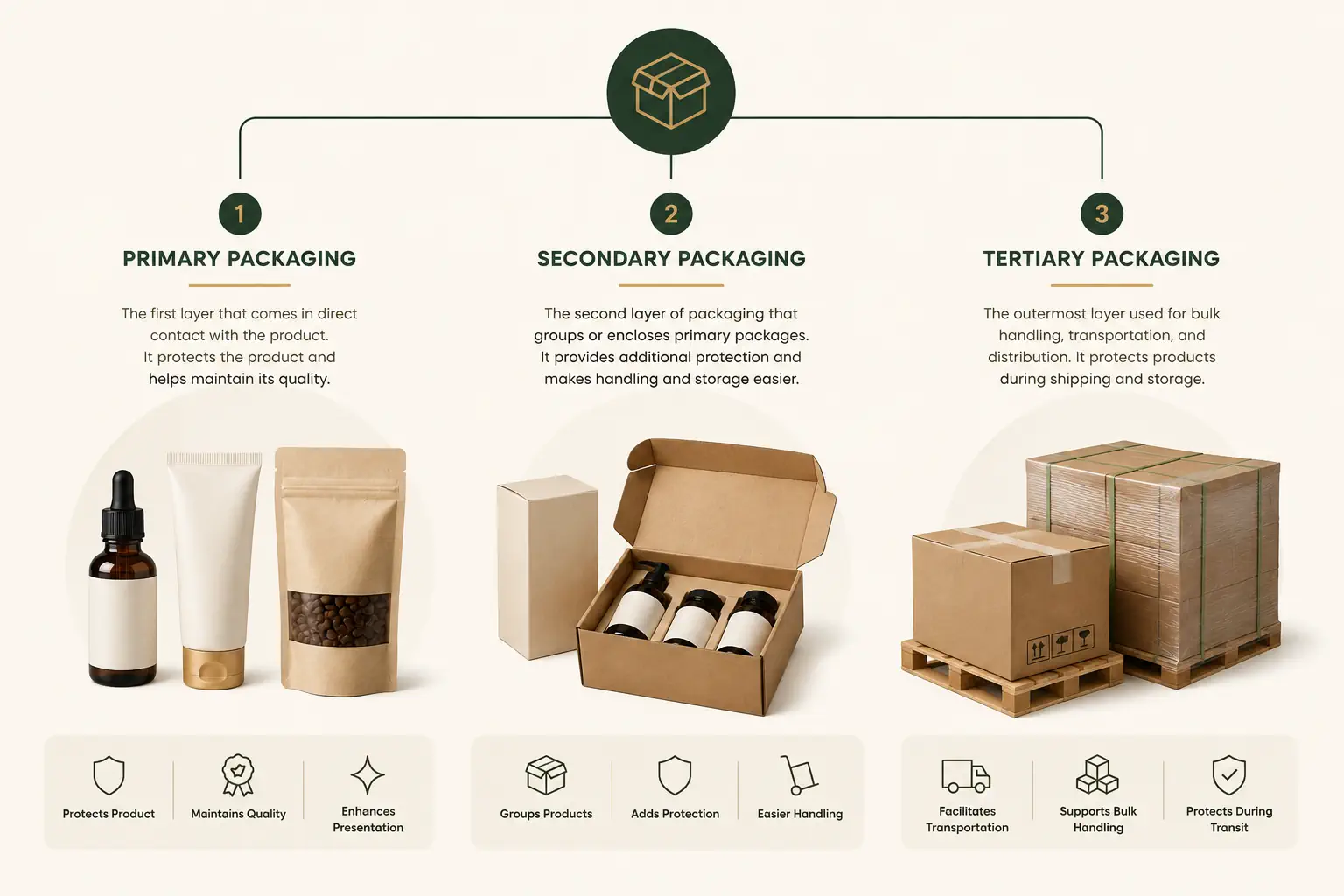
Primary packaging touches the product and carries the highest regulatory load; secondary packaging groups and brands items for retail, seen by the end customer but not touching the product; tertiary packaging groups secondary packages for bulk transport and is rarely seen by anyone but a warehouse worker. It’s worth reading our guides to primary packaging and tertiary packaging to see how all three layers work together — most real packaging systems use all three, and the mistake worth avoiding is optimizing one layer while ignoring how it affects the other two. A lighter secondary carton, for instance, can increase damage rates and push more cost into returns.
Secondary Packaging Design Considerations
A few things separate effective secondary packaging design from generic boxing. Stacking and palletizing efficiency matters more than it looks — a case size that doesn’t divide evenly onto a standard pallet wastes shipping capacity on every single shipment, not just one. Shelf-ready formats are increasingly favored by retail, with secondary packaging doubling as its own display to cut labor at the store level. And since this is the layer customers see pre-purchase, print quality and finishing — matte, gloss, spot UV — carry more weight here than on primary or tertiary layers, something our packaging design guide covers in full.
Frequently Asked Questions
What is an example of secondary packaging?
A cardboard case holding multiple bottles, a printed carton around a primary container, or a shrink-wrapped multipack are all secondary packaging.
Is secondary packaging the same as retail packaging?
Often, yes — most retail-facing branded packaging is secondary packaging, though some products, like a single unwrapped item on a peg hook, skip this layer entirely.
What's the difference between secondary and tertiary packaging?
Secondary packaging groups products and is typically customer-facing; tertiary packaging, like pallets and bulk crates, is built purely for shipping and warehousing and rarely reaches the end customer.
Does secondary packaging need to be recyclable?
It’s not universally required, but a growing number of markets have Extended Producer Responsibility (EPR) rules that make recyclability a cost factor even where it isn’t strictly mandated.