
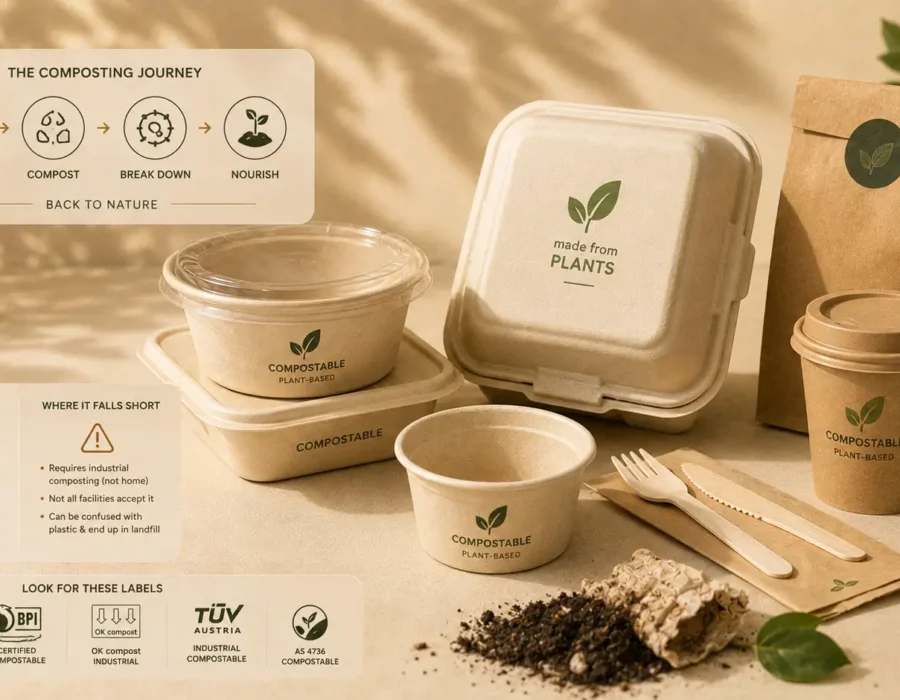
“Compostable” is one of the most misunderstood claims in food packaging, and the confusion is doing real damage to how brands and consumers evaluate it. A package labeled compostable doesn’t mean it will break down in a backyard compost bin, and it definitely doesn’t mean it will break down in a landfill — most compostable food packaging requires industrial composting facilities that a large share of the country doesn’t have access to.
Home Compostable vs. Industrial Compostable
This distinction is the single most important thing to understand about this material category. Home compostable packaging breaks down in a typical backyard compost setup, at ambient temperatures, generally within a matter of months. It’s a genuinely small subset of compostable packaging — most materials that carry a “compostable” claim don’t qualify for this standard, because it’s harder to formulate a material that breaks down at low, inconsistent home-compost temperatures.
Industrial compostable packaging requires the sustained high heat, humidity, and microbial activity of a commercial composting facility to break down within a reasonable timeframe, typically 90 to 180 days under those controlled conditions. This is the far more common certification, and it’s also where the disconnect happens: a package correctly labeled compostable under an industrial standard will not meaningfully break down in a home compost pile, and it will behave essentially like conventional plastic if it ends up in a landfill, since landfills lack the oxygen and heat needed for the process to work.
The practical implication is that compostable packaging is only a genuine environmental win if the end consumer actually has access to industrial composting collection, whether through municipal service or drop-off, and knows to use it rather than putting it in regular recycling or trash.
What Compostable Food Packaging Is Actually Made Of
Most compostable food packaging uses one of a handful of materials: PLA (polylactic acid), a plant-based bioplastic commonly derived from corn starch; PHA (polyhydroxyalkanoates), a newer bioplastic that breaks down under a wider range of conditions than PLA, including in some marine environments; or coated paper and molded fiber, where a compostable coating replaces the plastic lining conventional paper packaging would otherwise need for moisture resistance.
Each of these has different performance characteristics and different real-world composting requirements, which is part of why “compostable” as a single label undersells how different these materials actually are from each other — our broader packaging materials guide covers how these compare to conventional plastic and paper more generally.
Where Compostable Packaging Falls Short
It’s worth being direct about the real limitations rather than treating compostability as an unambiguous upgrade. Barrier performance is often weaker than conventional multi-layer plastic, particularly for products needing strong oxygen or moisture protection, which is why compostable options remain less common in categories like coffee and frozen food where barrier failure has an immediate, visible cost. Composting infrastructure access varies enormously by region, and a package is only as good as the consumer’s actual ability to compost it correctly. And if a compostable package ends up in conventional plastic recycling, it can contaminate that recycling stream, since compostable and conventional plastics generally can’t be processed together.
None of this means compostable packaging isn’t worth pursuing — it means the decision should be based on whether your customers have real access to the right disposal infrastructure, not on the word “compostable” alone, a tradeoff our sustainable packaging guide explores across categories beyond food.
Frequently Asked Questions
Is compostable food packaging better for the environment than plastic?
It depends heavily on whether the end consumer has access to the right composting infrastructure. Without that access, compostable packaging often ends up in a landfill behaving similarly to conventional plastic, which can undercut the environmental benefit.
Can compostable food packaging go in a home compost bin?
Only if it’s specifically certified home compostable, which is a smaller and stricter category than industrial compostable. Most compostable packaging on the market requires industrial composting facilities to break down properly.
What's the difference between compostable and biodegradable packaging?
Compostable materials break down into nutrient-rich organic matter within a defined timeframe under specific conditions, and typically require certification to make that claim. Biodegradable is a broader, less regulated term that just means a material will break down eventually, without a guaranteed timeframe or the requirement that it break down into anything useful.
Why doesn't compostable packaging work in a landfill?
Composting requires oxygen, heat, and microbial activity that landfills are specifically designed to minimize, since landfills are built to slow decomposition and limit methane production, not accelerate it.