
Pet food packaging is closer to human food packaging than most people expect. Kibble and wet pet food face nearly the same barrier and freshness challenges as their human-food equivalents — oxidation, moisture, and pest resistance — while operating at a different price point and, often, a lower regulatory bar than food meant for people.
Why Pet Food Packaging Needs Real Barrier Protection
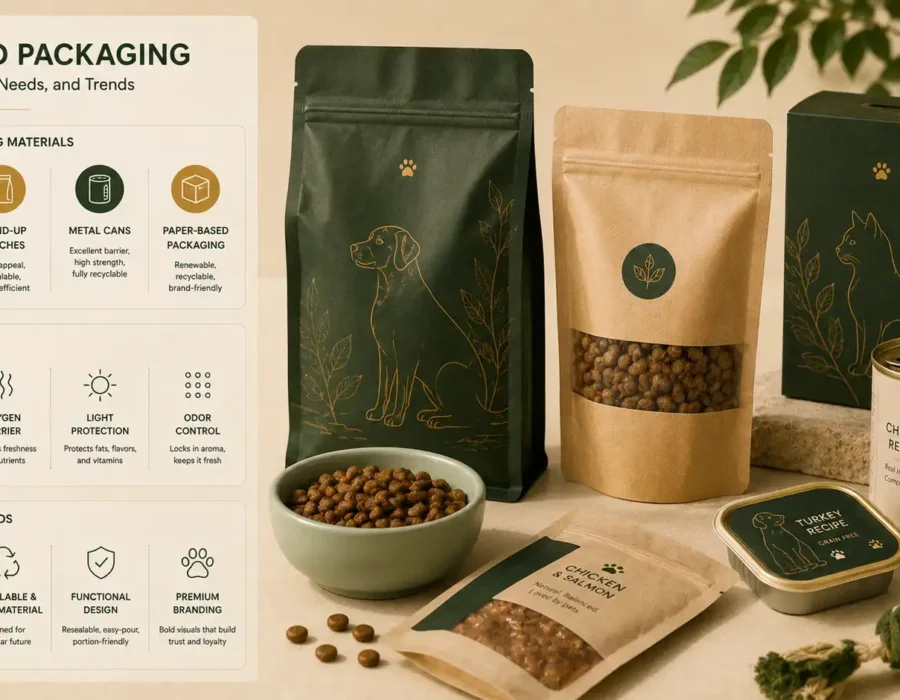
Dry kibble is high in fat content, which makes it genuinely vulnerable to oxidation and rancidity, similar to snack foods or nuts — packaging with poor oxygen barrier performance leads to kibble going stale and losing palatability well before its printed shelf-life date. Wet pet food, sold in cans or pouches, needs the same seal integrity as any shelf-stable human food product, since a compromised seal creates a real spoilage and safety risk. And because bags of dry pet food are often large and handled roughly — stacked, dropped, dragged out of a pantry — puncture resistance and seal strength under physical stress matter more here than in most human food packaging of comparable size.
This is part of why multi-layer barrier film and heavy-duty bags dominate dry pet food packaging, even though the category doesn’t carry the same regulatory scrutiny as human food — the same barrier tradeoffs we cover in our packaging materials guide apply here just as much as in human food packaging.
Common Materials and Formats
Multi-layer flexible bags, often with a resealable strip or zipper, are the standard for dry kibble, balancing barrier performance, durability, and cost at the large volumes typical of pet food packaging. Cans remain common for wet pet food, offering strong barrier protection and a long, established manufacturing infrastructure. Retort pouches, a flexible alternative to cans that can be heat-processed to achieve similar shelf stability, have grown as a lighter-weight option for wet food. And paper-plastic composite bags are used in some premium and smaller-format products, generally trading some barrier performance for a lower-plastic-content pitch.
Sustainable Pet Food Packaging
Sustainability search demand around pet food packaging is unusually high relative to the category’s overall size, and the underlying challenge mirrors what shows up in human food packaging: the multi-layer film that gives dry pet food its barrier protection is difficult to recycle through standard municipal systems, since separating the layers isn’t practical at scale. Recyclable mono-material film, similar in concept to what’s emerging in coffee and snack packaging, is the most active area of development, though it generally involves some barrier tradeoff versus conventional multi-layer film. A smaller number of brands have moved to compostable pouches, mostly in premium and smaller-format products where a modest barrier tradeoff is a more acceptable cost — the same compostable-vs-conventional tradeoff we walk through in our sustainable packaging guide.
Custom Pet Food Packaging
Custom pet food packaging follows a similar logic to custom food packaging generally: brands typically start with custom printing on stock bag or pouch formats to establish visual identity, then move to fully custom structures — different bag sizes, unique closures — once volume justifies the higher minimum order quantities that structural customization requires.
Frequently Asked Questions
Does pet food packaging need to meet the same standards as human food packaging?
Not exactly — pet food packaging generally faces a lower regulatory bar than human food, but it still needs to provide real barrier protection, since kibble’s high fat content makes it genuinely prone to oxidation and rancidity if the packaging underperforms.
Why does dry pet food need a resealable bag?
Large bag formats are used across many feedings, so a resealable closure protects freshness over the weeks a bag is typically open, rather than exposing the remaining kibble to oxygen after the first use.
Is sustainable pet food packaging as effective as conventional packaging?
Recyclable mono-material films are increasingly close to conventional multi-layer film in performance, though some options still trade off barrier protection, particularly compostable formats, which is worth checking against a product’s specific shelf-life needs.
What's the difference between pet food packaging for wet and dry food?
Dry pet food packaging prioritizes oxygen barrier and puncture resistance for large, roughly handled bags, while wet pet food packaging prioritizes seal integrity in cans or retort pouches similar to shelf-stable human food.