
Coffee is one of the more technically demanding categories in food packaging, for a reason most people outside the industry don’t expect: freshly roasted coffee actively releases carbon dioxide for days after roasting. Packaging that seals too tightly traps that gas and can literally cause a bag to burst; packaging that vents too freely lets in the oxygen that stales coffee faster than almost anything else affects it. Solving for both at once is the entire design problem behind coffee packaging.
The Core Problem: Degassing vs. Oxygen Protection
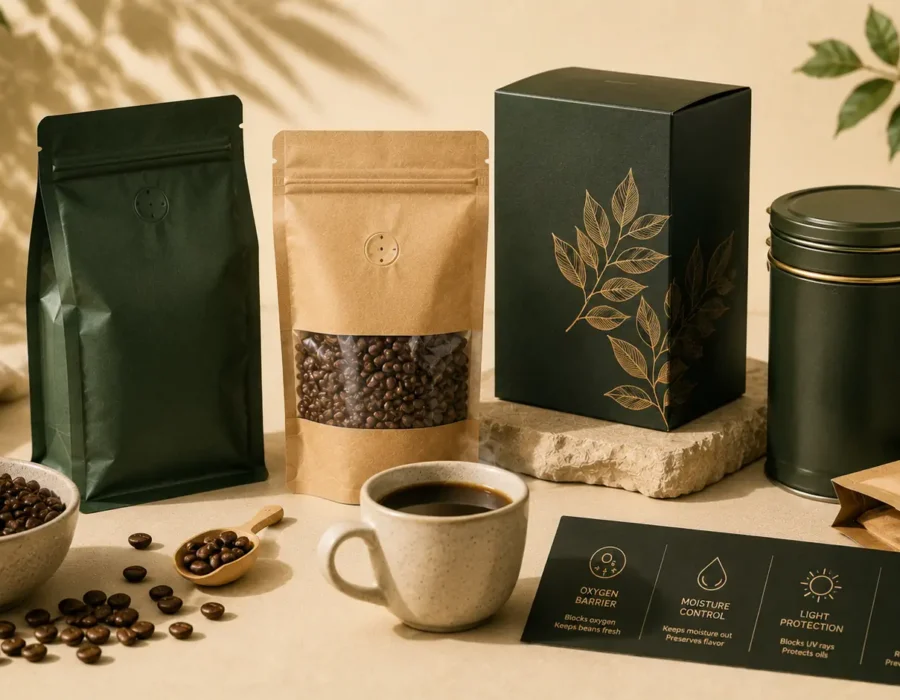
This tension is why coffee packaging looks different from most other food formats. One-way degassing valves, a small valve that lets CO₂ escape without letting oxygen in, are now close to standard on any coffee bag meant to be sold within days of roasting — bags without one either need to sit unsealed for a day or two after roasting, delaying packaging, or risk swelling and seal failure. Beyond the valve, the film itself needs strong oxygen and moisture barrier properties, since oxygen exposure is the single biggest driver of coffee going stale as the flavor compounds oxidize. Many coffee bags also use opaque or foil-lined film specifically because light exposure accelerates flavor degradation, similar to how it affects oils.
A bag that’s missing any one of these three elements will visibly underperform, either literally bursting on the shelf, or going stale faster than the roast date suggests it should.
Materials and Formats
Stand-up pouches with valves are the current standard for retail bagged coffee, balancing barrier performance, shelf presence, and reasonable cost. Flat-bottom bags are a stand-up pouch variant favored by specialty roasters for better shelf stability and a more premium look. Cans and rigid containers are less common now but still used for ground coffee and instant coffee, offering strong barrier protection without needing a valve. Single-serve pods and capsules are a separate packaging category entirely, optimized for individual-brew freshness rather than bag shelf life. Our packaging materials guide covers the underlying barrier and material properties behind all of these.
Sustainable Coffee Packaging
Coffee packaging sits in a genuinely difficult spot for sustainability: the multi-layer films that give coffee its strong barrier protection are exactly the kind of material that’s hardest to recycle through standard municipal systems, since separating the layers isn’t practical at scale. This has pushed real movement toward mono-material films, which use a single, more easily recyclable plastic type engineered to still deliver adequate barrier performance, and toward compostable options, though compostable coffee packaging still generally underperforms multi-layer film on barrier protection — a real tradeoff, not a solved problem yet. Our sustainable packaging guide covers this tension across categories in more depth.
Sourcing Coffee Packaging
Most coffee roasters, especially smaller and specialty ones, buy from suppliers specializing in coffee-specific packaging, meaning pre-made pouches with valves already installed, rather than commissioning fully custom structures from scratch, since valve integration is a specialized manufacturing step. Custom printing and branding on stock pouch formats is the more common path to a distinct look without the cost of a fully custom structure, a general approach our food packaging supplies guide covers in more depth.
Frequently Asked Questions
Why do coffee bags have a small valve on them?
The valve lets carbon dioxide released by freshly roasted beans escape without letting oxygen in, preventing both bag swelling or bursting and premature staling from oxygen exposure.
What is the best material for coffee packaging?
Multi-layer barrier film with a degassing valve is the current standard for balancing freshness, cost, and shelf presence. Fully recyclable mono-material films are a newer, growing alternative, though sometimes with a modest barrier performance tradeoff.
Does coffee packaging need to be opaque?
Not strictly required, but opaque or foil-lined packaging protects against light-driven flavor degradation, which matters more the longer a bag is expected to sit on a shelf before purchase.
Can coffee packaging be fully compostable?
Some compostable coffee packaging exists, but it generally trades off some barrier performance compared to conventional multi-layer film, worth verifying actual shelf-life data for a specific compostable option rather than assuming parity with standard packaging.