
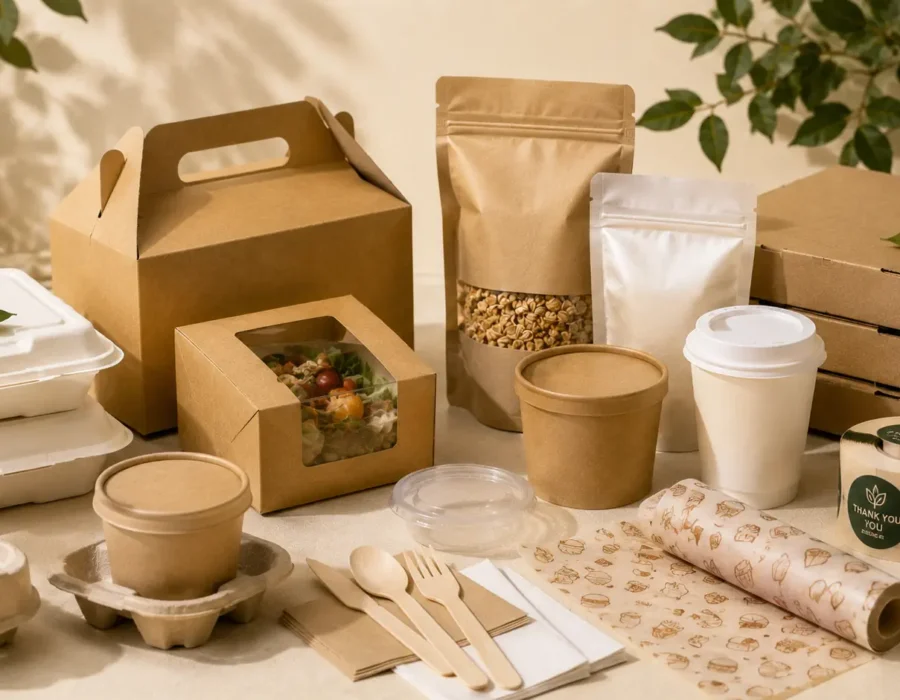
“Food packaging supplies” covers a wide range of things — pouches, containers, labels, boxes, tape, and the raw materials that go into all of them. What actually matters when you’re buying isn’t the category name, it’s the decision underneath it: do you buy off-the-shelf stock packaging, or commission something custom? That single choice drives almost everything else — cost, lead time, minimum order quantity, and how much control you have over the final result.
Stock Supplies vs. Custom Packaging
Stock, or off-the-shelf, supplies are pre-made in standard sizes and often standard branding-free designs — plain kraft pouches, generic clamshells, unbranded corrugated boxes. They’re available in smaller quantities, ship faster, and cost less per unit at low volume. Custom packaging is built to your specifications — exact dimensions, printed branding, specific barrier properties — and typically requires a minimum order quantity that can run into the thousands of units, with lead times measured in weeks, not days.
The practical rule most brands land on: start with stock supplies while volume and product-market fit are still uncertain, and move to custom once you have consistent enough volume to justify the MOQ and upfront tooling cost. Switching too early ties up cash in packaging inventory before you know it’s the right packaging; switching too late means shipping unbranded product longer than necessary.
What to Look for in a Food Packaging Supplier
Not all suppliers are interchangeable, even within the same material category. Confirm food-grade certification for the specific materials in the markets you sell into, since requirements differ between regions. Get minimum order quantities up front — they vary enormously, from a few hundred units for some stock suppliers to tens of thousands for certain custom print runs — before you get attached to a design. Ask specifically about reorder lead time, not just initial production, since the two can differ significantly. Treat a supplier who won’t send physical samples before a full production run as a real risk, especially for anything touching food directly. And weigh location relative to your fulfillment: a supplier overseas may be cheaper per unit but adds shipping time and cost that can erase the savings once you factor in freight and duties.
Buying Wholesale vs. Buying Bulk
These terms get used interchangeably but aren’t quite the same thing. Wholesale typically means buying pre-made stock packaging at a volume discount, usually from a distributor rather than a manufacturer. Bulk more often refers to buying larger quantities of a specific item, which can be either stock or custom, to bring down the per-unit price. If you’re early-stage and buying wholesale stock packaging, expect meaningfully lower minimums than custom, often in the hundreds rather than thousands of units, but less negotiating room on price since you’re not the only buyer of that exact product.
Realistic Cost Expectations
Costs vary widely by material and format, but as a general pattern, stock packaging typically runs lower per-unit than custom at low volume, while custom packaging’s per-unit cost drops faster as volume increases, meaning the crossover point where custom becomes cheaper than stock usually arrives sooner than most first-time buyers expect. Getting a real quote at your actual target volume is the only reliable way to know where that crossover sits for your specific product.
Frequently Asked Questions
Where do small food brands typically source packaging supplies?
Most start with wholesale distributors or smaller-MOQ custom packaging companies rather than going directly to large manufacturers, since manufacturer minimums are often too high for early-stage volume.
What's the minimum order quantity for custom food packaging?
It varies by material and format, but custom printed packaging commonly starts in the low thousands of units. Some digital printing options offer lower minimums at a higher per-unit cost, worth asking about specifically if volume is still small.
Do food packaging supplies need to be certified?
Yes — any material in direct contact with food needs to be certified food-safe for the markets you’re selling in. This is a real compliance requirement, not optional documentation, and a supplier should be able to provide certification on request.
Is it cheaper to buy food packaging supplies locally or overseas?
Overseas suppliers often quote lower per-unit prices, but freight, duties, and longer lead times can close or reverse that gap, especially at lower order volumes where shipping cost isn’t spread across as many units.