
Food packaging has a job that most other packaging categories don’t: it’s not just protecting a product, it’s actively keeping it safe to eat. That single difference is why food packaging is more regulated, more barrier-dependent, and generally more technically demanding than packaging for almost any other consumer category — a packaging failure here isn’t a cosmetic problem, it’s a safety one.
This guide covers what food packaging actually needs to do, the main material and format choices, and how to think about the tradeoffs.
What Food Packaging Has to Do
Every food packaging decision is ultimately answering four questions: will it keep the product safe, preventing microbial contamination and physical damage; will it keep the product fresh for as long as it needs to be sold, since barrier performance against oxygen, moisture, and light drives shelf life directly; does it meet labeling and safety requirements, given that ingredients, allergens, and nutrition information are legally mandated in most markets; and does it work for how the product is actually sold and used, since resealability, portion control, and shelf presentation all affect real-world performance, not just lab performance. A package that nails barrier performance but is expensive to produce at scale, or one that looks great but doesn’t reseal properly, is still a failed design — food packaging has to satisfy all four at once, not just the one that’s easiest to test.
Food Packaging Materials
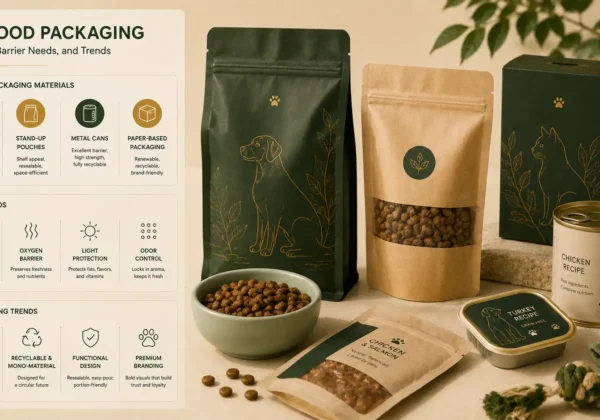
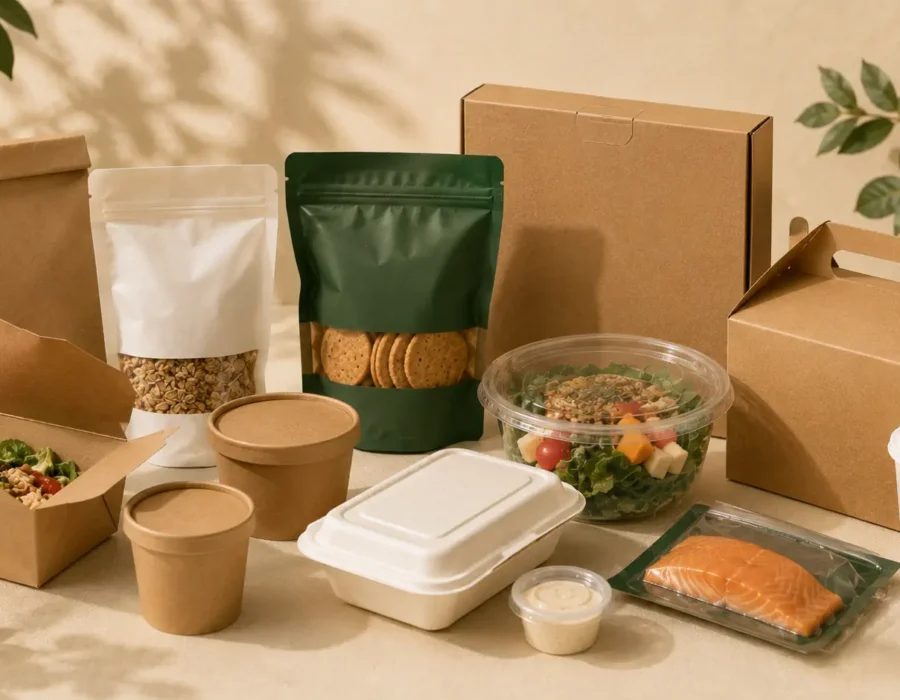
Material choice in food packaging is more constrained than in most other categories, because everything has to be food-grade — safe for direct or indirect contact with what’s being eaten, a subject our full packaging materials guide covers broadly. Flexible film and pouches are the fastest-growing format for snacks, coffee, and frozen food, thanks to strong barrier-to-weight performance and low material cost. Rigid plastic — trays, tubs, clamshells — is used where structural protection matters more than flexibility, like produce or bakery items. Glass, inert and unaffecting to flavor, is still the standard for sauces, preserves, and premium beverages. Metal, in cans and foil, gives excellent oxygen and light barrier and is standard for shelf-stable canned goods. And paperboard and molded fiber are increasingly used for dry goods and as trays replacing plastic in bakery and produce packaging.
Food Packaging by Category
Different food categories have genuinely different packaging problems, not just different branding. Candy and confectionery packaging is mostly about shelf appeal and moisture protection, with barrier requirements usually modest compared to fresh or frozen food. Coffee is one of the more technically demanding categories, since packaging has to manage degassing from freshly roasted beans while blocking oxygen and light. Bakery packaging balances moisture retention against mold risk, often with less barrier protection than other categories since bakery products are typically sold and consumed faster. Pet food is closer to human food packaging than most people expect, with similar barrier and freshness requirements at a different price point.
Food Packaging Labels and Compliance
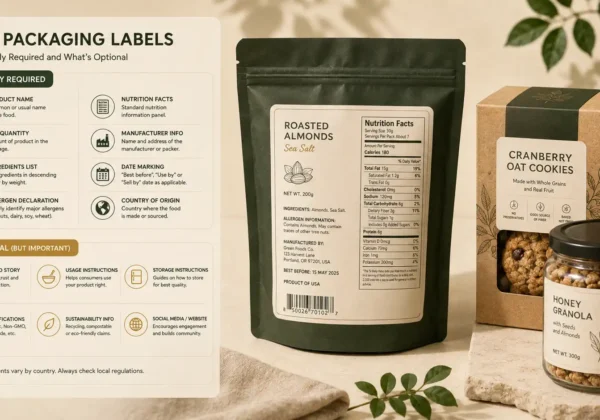
Food packaging carries more mandatory information than almost any other packaging category — ingredients, allergens, nutrition facts, and net weight are legally required in most markets, and requirements differ meaningfully between regions. Getting this wrong isn’t just a redesign cost; mislabeled allergens in particular are one of the most common causes of food recalls, a topic our broader packaging regulations guide covers by market.
Sustainability in Food Packaging
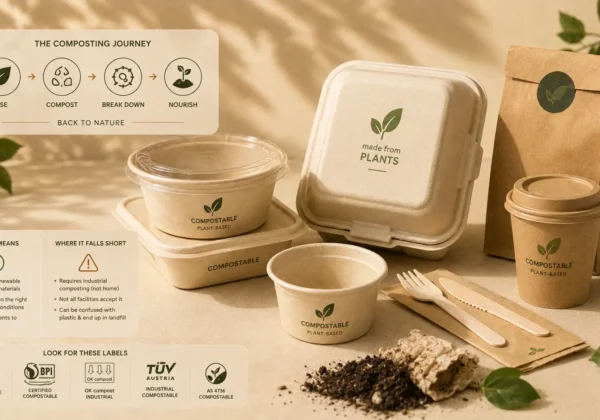
Food packaging sits at an unusually direct tension point in the sustainability conversation: reducing packaging material is good for the environment, but reducing it too far increases food waste, which has its own, often larger, environmental cost. A well-barriered plastic pouch that keeps produce fresh for two extra weeks can have a lower net footprint than an unpackaged alternative that spoils faster. This is why eco-friendly food packaging is rarely as simple as switching materials — a tension our sustainable packaging guide explores in depth, and one we’ll return to specifically for food across the compostable, biodegradable, and eco-friendly variations of this cluster.
Sourcing Food Packaging
Whether you’re buying food packaging supplies off the shelf or commissioning custom packaging, the sourcing path differs by scale. Small and early-stage brands typically buy from wholesale food packaging suppliers with lower minimum order quantities, accepting less customization for faster, cheaper access — a path we cover directly in our food packaging supplies buyer’s guide. Growing brands move toward custom food packaging, with purpose-built dimensions, branding, and barrier specs, once volume justifies the higher minimums and upfront cost.
Food Packaging Equipment
Beyond the package itself, most food brands past a certain volume need to think about the equipment that fills and seals it — form-fill-seal machines, vacuum sealers, and tray sealers all have different throughput and product compatibility profiles.
Frequently Asked Questions
What is the most common type of food packaging?
Flexible plastic film and pouches are the most widely used format by volume, largely due to their strong barrier-to-weight ratio and low material cost relative to rigid alternatives.
Is food packaging always required to be recyclable?
Not universally, but a growing number of markets have Extended Producer Responsibility (EPR) laws that make recyclability a real cost factor even where it isn’t strictly mandated.
How do I choose between plastic, paper, and glass for a food product?
It depends primarily on the barrier protection your product needs — a product sensitive to oxygen or moisture will need better-performing, usually plastic or metal, packaging than one that’s shelf-stable and low-risk, like dry goods.