

Packaging is any material, structure, or system used to contain, protect, transport, or present a product — from the moment it leaves a production line to the moment a customer opens it. That covers a lot of ground: a glass bottle, the cardboard case it ships in, the label on the front, and the pallet wrap holding a thousand of them together are all “packaging,” just at different stages of the product’s journey.
For most people running or building a brand, though, the useful question isn’t the dictionary definition — it’s what packaging actually has to do, what it’s made of, what it costs, and where to start. This guide covers all of that at a high level.
What Packaging Actually Does
Every packaging decision is really answering one or more of five jobs:
- Containment — holding a product (liquid, powder, fragile item) in a stable form
- Preservation — for products like food or pharmaceuticals, extending shelf life and maintaining safety
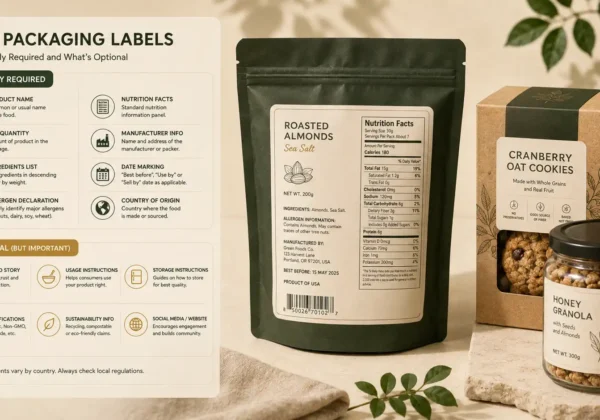
- Communication — labeling, branding, and legally required information (ingredients, warnings, barcodes)
A single package usually does more than one of these at once. A bag of coffee protects the beans from oxygen and light, communicates the roast and origin, and is designed to reseal for convenience — all in one piece of flexible film.
The Three Levels of Packaging
Almost every packaging system is built from three layers, each with a different job. Primary packaging is what touches the product directly — the bottle, the wrapper, the blister pack. It’s the layer a customer interacts with first and the one most tightly regulated for food and pharmaceutical products, since it’s in direct contact with what’s being consumed or applied.
Secondary packaging groups primary packages together — a cardboard box holding twelve bottles, a printed carton around a tube of toothpaste. This is usually where branding and retail shelf presence live.
Tertiary packaging, sometimes called transit or bulk packaging, is built for shipping and warehousing, not the end customer — shrink-wrapped pallets, bulk crates, stretch film. It rarely reaches the consumer at all. If you want the full side-by-side breakdown of how the three compare and when to focus on each, we cover that separately in our primary vs. secondary vs. tertiary packaging comparison.
Common Packaging Materials
Material choice usually comes down to a tradeoff between protection, cost, weight, and sustainability. Corrugated cardboard is the default for shipping boxes and secondary packaging — strong for its weight, cheap, and widely recyclable. Flexible packaging (films, pouches, bags) is lightweight with a low material cost and good barrier properties, though it’s harder to recycle than rigid formats. Rigid plastic is durable and moldable into complex shapes, which is why it’s common for cosmetics and household products. Glass is inert, won’t react with contents, and is fully recyclable, but it’s heavy and fragile. Molded pulp and paperboard are seeing more use as a lower-impact alternative to foam and rigid plastic.
There’s rarely a single “best” material — a supplement brand optimizing for shelf stability will make different choices than a shipping-heavy e-commerce brand optimizing for weight and damage rates. We go deep on all of these tradeoffs, with real cost and sustainability comparisons, in our packaging materials guide.
Packaging Across Industries
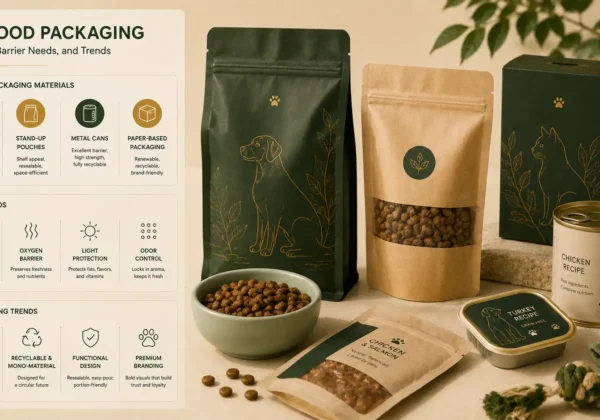
Packaging requirements shift significantly by industry, mostly because the risk of getting it wrong is different. Food and beverage packaging is built around shelf life, contamination prevention, and increasingly sustainability — a mislabeled allergen or a barrier failure is a safety issue, not just a cosmetic one, something we cover in full in our food packaging guide. Pharmaceutical and medical packaging carries the heaviest regulatory load of any category — child-resistant closures, tamper-evidence, and validated barrier performance are often legal requirements, not design choices. Cosmetics and beauty packaging leans harder on presentation and unboxing experience, since purchase decisions are more visually and emotionally driven. E-commerce and shipping packaging optimizes for a different variable entirely: damage rate and dimensional weight, since shipping cost is often tied directly to package size.
Packaging Design
Design sits on top of all of the above — it’s where material, structure, and branding come together into something a customer actually picks up. Good packaging design balances three things that often pull in different directions: shelf stand-out, production cost, and the practical constraints of the material and machinery being used to fill and seal it. A design that looks great as a render can still fail if it can’t be manufactured at the volumes and cost a brand needs.
Sustainability
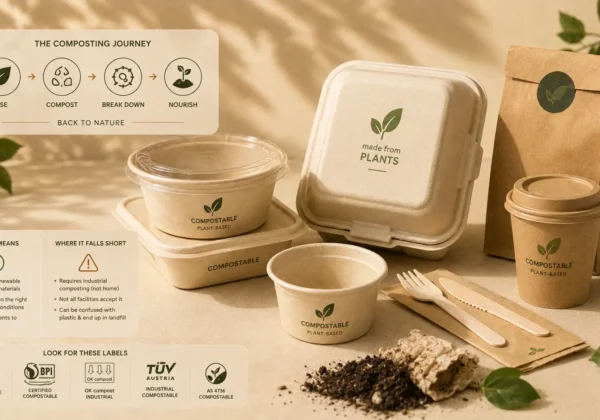
Sustainable packaging isn’t one specific material — it’s an outcome, and it can be pursued several different ways: switching to recyclable materials, reducing overall material weight, using recycled content, or moving to compostable formats. These options aren’t interchangeable — a compostable pouch won’t help a brand if there’s no industrial composting infrastructure in the market it’s sold in, which is one of the more common mistakes brands make when they treat “sustainable” as a single checkbox rather than a set of tradeoffs specific to their supply chain and market, a topic our sustainability guide breaks down in detail.
What Packaging Costs
Packaging cost is driven by four main levers: material, print/finishing complexity, order volume (custom packaging has real minimum order quantities), and supplier location relative to where the product is sold. As a rough starting point, packaging typically runs somewhere between 5–15% of landed product cost for consumer goods, though this varies widely by category. Our guide to choosing a packaging company breaks down sourcing and pricing in more detail.
Regulations
Packaging is regulated more than most people expect — labeling requirements, recyclability claims, child-resistant closures for certain product categories, and, in a growing number of markets, Extended Producer Responsibility (EPR) laws that make brands financially responsible for the packaging waste they create. Requirements differ by country and, in some cases, by state or region within a country, which matters a lot for any brand selling across multiple markets — our packaging regulations guide covers this by market.
Frequently Asked Questions
What's the difference between packaging and packing?
Packaging refers to the materials and design used to contain and present a product. Packing is the process of putting products into that packaging — the action, not the material.
What is packaging design?
Packaging design is the process of developing the structure, materials, and visual elements of a package — balancing protection, manufacturability, cost, and shelf appeal.
Is packaging the same as branding?
No, though they overlap. Branding is the broader identity of a product or company; packaging is one of the physical touchpoints where that identity shows up, alongside labeling, color, and typography choices.
What is the most common packaging material?
By volume, corrugated cardboard and flexible plastic films are the two most widely used packaging materials globally, largely because of their low cost-to-protection ratio.