

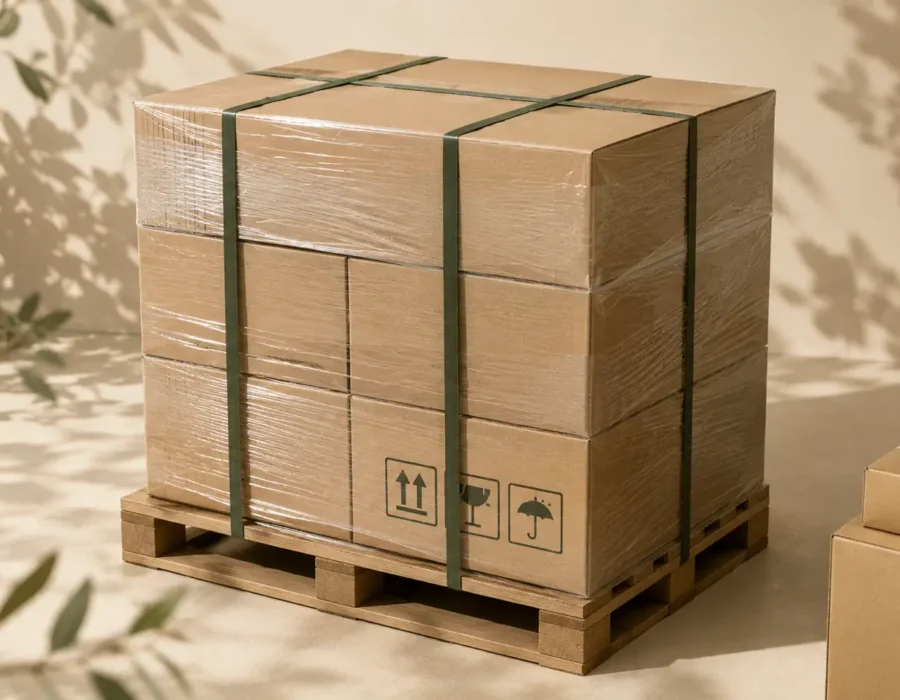
Tertiary packaging — sometimes called transit or bulk packaging — is the outermost layer of a packaging system, built to move groups of products safely through warehousing and shipping. Unlike primary and secondary packaging, it’s almost never designed with the end customer in mind. Its entire job is protecting a large quantity of product between a factory and a warehouse, or a warehouse and a store — a customer typically never sees it at all.
What Counts as Tertiary Packaging
If secondary packaging is what a shopper sees on a shelf, tertiary packaging is what a forklift operator sees in a warehouse. Shrink-wrapped pallets stacking dozens of secondary cases together, bulk shipping crates and gaylord boxes, stretch film wrapped around palletized loads, and corner protectors are all common examples. None of these are built to look good — they’re built to survive being stacked, forklifted, stored in a warehouse for weeks, and shipped across long distances without the contents shifting or getting crushed.
Why Tertiary Packaging Is Easy to Underinvest In
Because it’s invisible to customers, tertiary packaging is one of the first places brands try to cut cost — and one of the places where cutting cost most reliably backfires. A pallet that isn’t wrapped tightly enough, or a case that isn’t strong enough to bear the weight of the cases stacked on top of it, doesn’t fail gracefully. It fails as damaged product, which shows up as returns, chargebacks from retailers, and, for a growing brand shipping direct to consumers, one-star reviews that have nothing to do with the product itself.
The economics also work differently here than for primary or secondary packaging. Tertiary packaging isn’t priced per unit sold, it’s priced per shipment, which means small savings compound quickly across thousands of pallets a year — but so do small failures.
Materials Used in Tertiary Packaging
Stretch and shrink film are the standard for holding palletized loads together, low cost per pallet and fast to apply. Heavy-duty corrugated, often double or triple wall, is used for bulk crates and gaylords where a standard single-wall case isn’t strong enough. Wood and engineered pallets form the base structure most tertiary packaging is built on, and steel or plastic strapping is used where shrink wrap alone isn’t enough to secure a load. Material choice here is driven almost entirely by stacking strength and handling durability rather than appearance — our materials guide covers how these properties compare across categories.
How Tertiary Packaging Fits With Primary and Secondary
The three layers are designed together, not in isolation — a secondary case that’s slightly undersized for standard pallet dimensions creates wasted space, and cost, at the tertiary level on every single shipment. This is one of the more common, avoidable cost leaks in packaging systems: optimizing each layer separately instead of as one system, something we break down further in our guide to packaging costs.
Frequently Asked Questions
What is an example of tertiary packaging?
A shrink-wrapped pallet, a bulk shipping crate, or a gaylord box used to move products in bulk between facilities are all tertiary packaging.
Does tertiary packaging need branding?
Rarely — since it’s not customer-facing, tertiary packaging is typically unbranded or carries only shipping and handling information, like weight or stacking instructions.
What's the difference between tertiary packaging and freight packaging?
They’re largely the same concept — tertiary is the formal packaging-industry term, while freight or transit packaging describes the same function in shipping and logistics contexts.
Is a shipping pallet itself tertiary packaging?
The pallet is the base the tertiary packaging is built around; the wrap, strapping, and protective elements added to it are what’s typically classified as the packaging itself.